
The Phantom Canoe- A Legend of Lake Tarawera — History & Facts
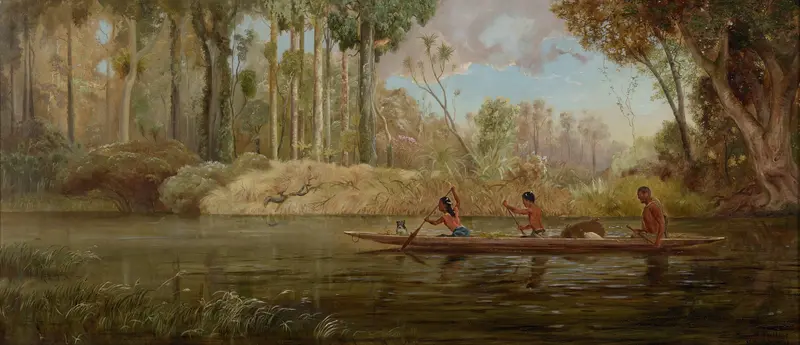
Each brushstroke invites reflection, prompting us to consider how the essence of stillness can hold profound narratives. Look to the foreground where an ethereal canoe glides silently across the water's mirror-like surface. Notice how the rich blues and greens blend seamlessly, creating a sense of depth and tranquility. The light filtering through the surrounding trees casts delicate shadows, emphasizing the canoe’s isolation while providing a gentle contrast to the vivid colors.
It draws the viewer’s eye, urging a closer examination of the whispered legends that dwell in this quiet moment. At the heart of the piece lies a juxtaposition of tranquility and mystery. The canoe appears both inviting and elusive, hinting at stories untold, perhaps echoing local folklore. The reflective water symbolizes the duality of existence: the visible surface and the depths below, where unseen emotions and histories resonate.
This sense of enigma envelops the scene, inviting contemplation of what lies beneath the calm exterior. In 1888, Kennett Watkins created this work during his time in New Zealand, a period marked by a growing appreciation for the region’s natural beauty. As artists sought to capture the landscapes and stories of their surroundings, Watkins explored the intersection of reality and myth. The painting reflects not only his technical prowess but also his engagement with cultural narratives, capturing the spirit of a land steeped in legend.
More Artworks by Kennett Watkins
More Landscape Art

Starry Night
Vincent van Gogh

View of Delft
Johannes Vermeer

Water Lilies
Claude Monet

The Grand Canal, Venice, looking north-west from the Ca' Corner to the Ca' Contarini degli Scrigni, with the campanile of Santa Maria della Carità
Canaletto

Windsor Castle
Canaletto

The Grand Canal looking North-East from the Palazzo Dolfin-Manin to the Rialto Bridge
Canaletto