
The Piazza of Saint Peter’s Seen through an Arch of the Basilica — History & Facts
In the act of capturing a moment, an artist weaves a legacy that transcends the boundaries of time and space, inviting viewers into a suspended reality. Focus on the arch that frames the magnificent spectacle of Saint Peter's Basilica, directing your gaze to the grandiosity of the piazza beyond. The soft interplay of light and shadow dances across the marble surfaces, highlighting the architectural elegance while infusing a sense of movement and life within the scene. The warm hues of the sky blend seamlessly with the cool stone, creating a harmonious balance that draws the eye deeper into the composition. Within this carefully crafted vista, a tension emerges between the permanence of stone and the ephemeral nature of human activity.
Notice the figures below, mere silhouettes against the monumental backdrop, suggesting the smallness of humanity in contrast to divine architecture. The arch acts as both a passage and a barrier, symbolizing the intersection of the sacred and the everyday, a reminder of the legacy left by generations before. Giacomo Quarenghi painted this noteworthy work between 1778 and 1779, during a period of artistic transition in Europe. He was immersed in the neoclassical movement, capturing the grandeur of ancient Rome while adapting to contemporary tastes.
This was a time when artists strived to reconcile the past with the evolving ideals of their own era, marking a significant moment in the history of art that Quarenghi navigated compellingly.
More Artworks by Giacomo Quarenghi
Browse all →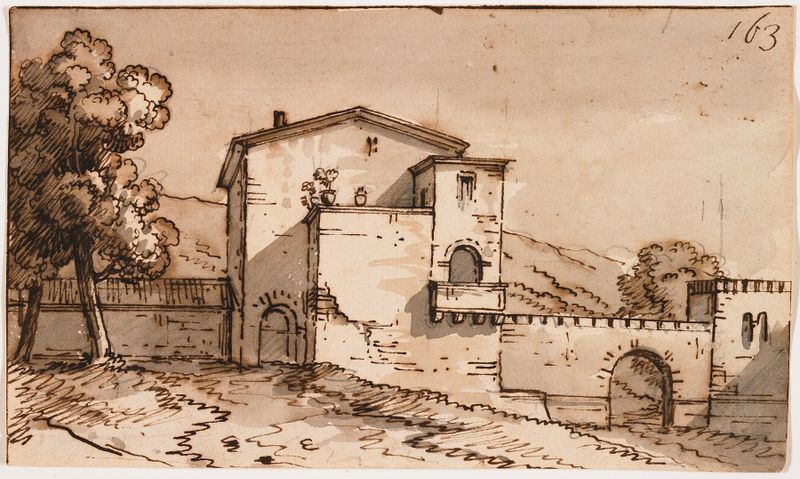
More Architecture Art
Browse all →
The statue of Liberty
Frédéric Auguste Bartholdi

View of Houses in Delft, Known as ‘The Little Street’
Johannes Vermeer

View of Houses in Delft, Known as ‘The Little Street’
Johannes Vermeer

The Cathedral in Rouen. The portal, Grey Weather
Claude Monet

The yellow house
Vincent van Gogh

The Church in Auvers-sur-Oise, View from the Chevet
Vincent van Gogh