
The Pietà — History & Facts
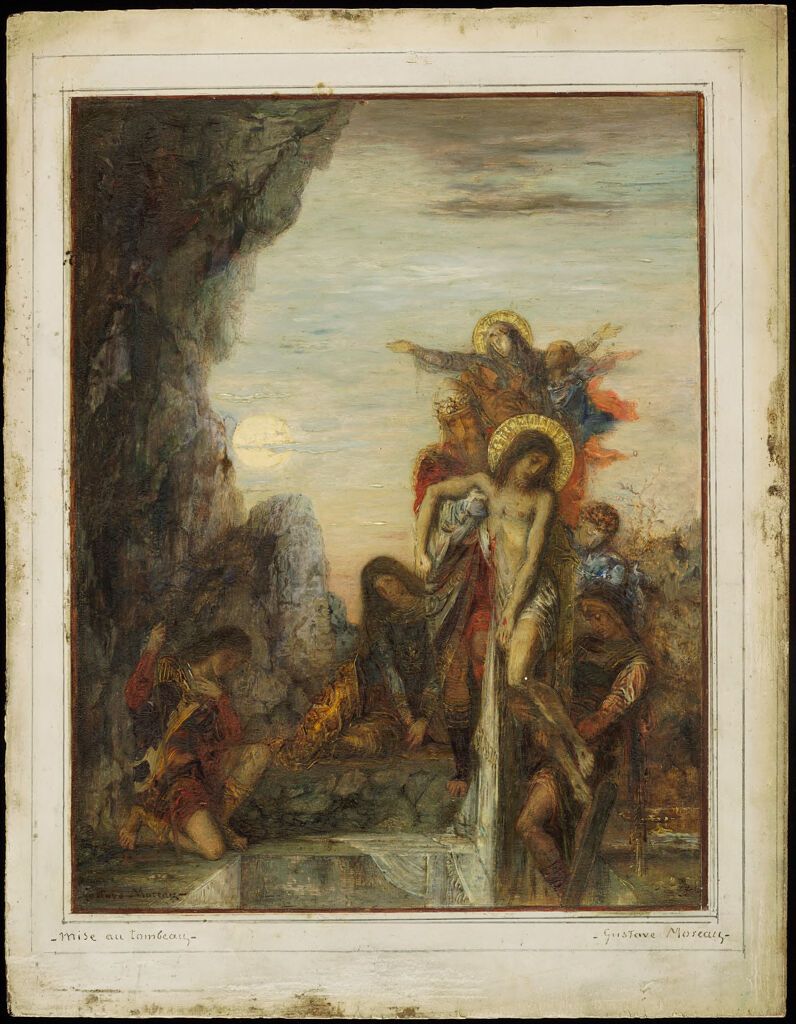
Can paint confess what words never could? In Gustave Moreau’s evocative work, The Pietà, the moment becomes a silent testament to grief and love, where movement is infused into every brushstroke, expressing a deep emotional resonance that transcends language. Look closely at the figures entwined in a tender embrace at the center. Notice how the flowing drapery wraps around them, creating a sense of enveloping warmth amidst the desolation. The muted color palette, dominated by soft blues and earth tones, invites your gaze while the delicate highlights on their skin suggest an otherworldly glow, illuminating their sorrow.
The interplay of light and shadow beautifully captures the tender yet agonizing moment, making you feel the heaviness of their embrace. Yet, within this intimate scene lies a profound contrast—the stillness of death against the pulse of life. The figures are not merely static; they convey a sense of movement, as if the sorrowful mother wishes to cradle her lifeless child back to warmth. The subtle tension between the figures speaks of an ache that resonates with anyone who has experienced loss, while Moreau’s intricate details—like the soft texture of the fabric or the delicate, almost imperceptible tears—invite contemplation on the nature of love and mourning. Created around 1867, this painting emerged during a time when Moreau was grappling with personal loss and the complexities of the Romantic movement in art.
In the wake of his own tragedies, he sought to explore the depths of human emotion, marking a pivotal point in his career as he infused his work with symbolic depth and rich psychological insight. This was a time when artists were beginning to challenge traditional representations and delve into the inner workings of the human soul, a journey encapsulated perfectly in this haunting piece.
More Artworks by Gustave Moreau
Browse all →

More Religious Art
Browse all →
The Return of the Prodigal Son
Rembrandt van Rijn

The Garden of Earthly Delights
El Bosco

Count Orgaz’ funeral
El Greco

The Hundred Guilder Print: the central piece with Christ preaching, the plate arched
Rembrandt van Rijn

The Descent from the Cross
Rogier van der Weyden

The return of the prodigal son
Rembrandt van Rijn