
The Rialto Bridge in Venice — History & Facts
Could beauty survive in a century of chaos? As the world teetered on the brink of conflict, the artistic heart of Venice whispered stories of resilience through its timeless architecture. Look to the left, where the Rialto Bridge arches majestically over the shimmering waters of the Grand Canal, its contours softened by the gentle brushstrokes that invoke a sense of harmony. Notice how the warm hues of soft ochres and deep blues blend seamlessly, reflecting both the sky and the water below, inviting a moment of serene contemplation. The figures scattered along the bridge and in the boats beneath it are rendered with a delicate precision, their ethereal movements echoing the timeless dance between the human spirit and nature. Yet, beneath the enchanting surface lies an undercurrent of tension.
The juxtaposition of bustling activity against the stillness of the water speaks to the fragility of peace amidst growing unrest. Each figure, captured in a fleeting moment, symbolizes both the liveliness of life and the looming shadows of uncertainty that were beginning to engulf Europe. The vibrant colors, while beautiful, hint at a fleeting joy—reminding us of the ephemeral nature of such moments. In 1913, when this work was created, Schmalzigaug was living in Paris, part of a vibrant artistic community grappling with shifts in style and ideology.
The world was on the precipice of World War I, and artists were reflecting the chaos and beauty of their environments. This piece captures a moment of stillness in a rapidly changing world, illustrating the artist’s hope that beauty could persist even in the darkest times.
More Artworks by Jules Schmalzigaug
Browse all →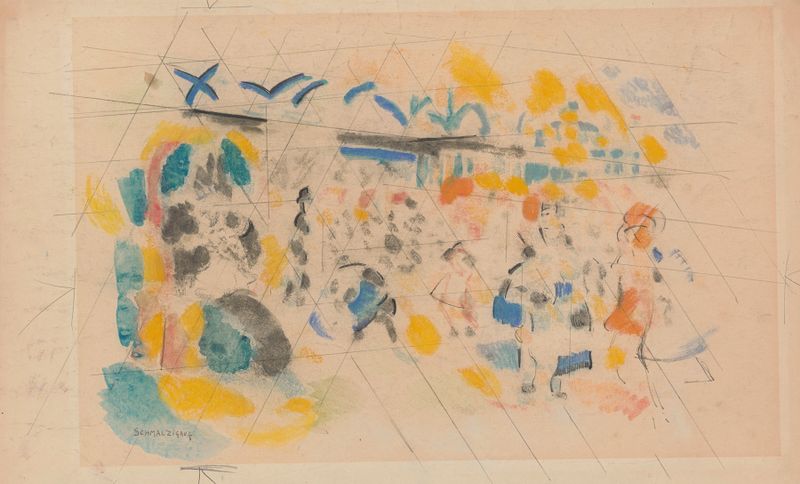
More Architecture Art
Browse all →
The statue of Liberty
Frédéric Auguste Bartholdi

View of Houses in Delft, Known as ‘The Little Street’
Johannes Vermeer

View of Houses in Delft, Known as ‘The Little Street’
Johannes Vermeer

The Cathedral in Rouen. The portal, Grey Weather
Claude Monet

The yellow house
Vincent van Gogh

The Church in Auvers-sur-Oise, View from the Chevet
Vincent van Gogh