The White Terraces — History & Facts
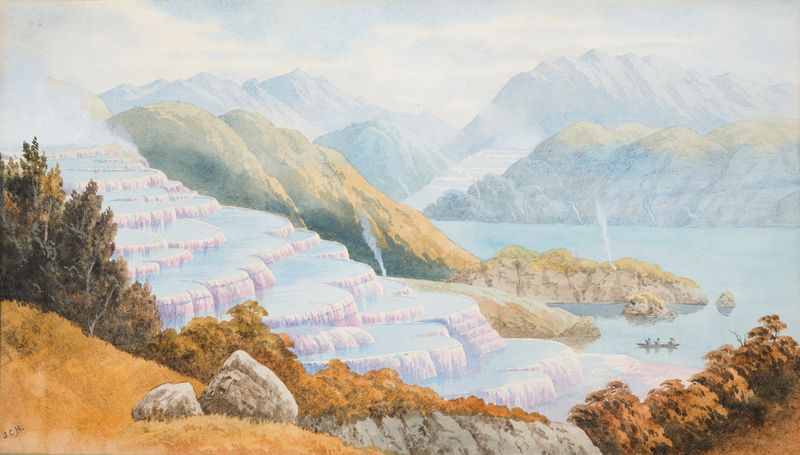
Can paint confess what words never could? The essence of memory lingers in the ethereal beauty of the landscape, whispering stories to those attuned to its quietude. Look to the left at the undulating forms of the terraces, their pristine white surfaces softly bathed in the golden glow of sunlight. The artist's deft brushwork creates a tactile texture, inviting the viewer to trace the contours of each terrace as they cascade downwards. Notice how the play of light and shadow dances across the composition, evoking both clarity and mystery, while the gentle blues of the sky envelop the scene, adding depth and serenity. In the foreground, the delicate details of the foliage contrast with the starkness of the terraces, suggesting the entwined relationship between nature and human creation.
The stillness of the water mirror reflects not only the landscape but also a sense of nostalgia, prompting contemplation on what has been lost or cherished. The balance of vivid hues against muted tones invites viewers to consider their own memories, encouraging an emotional resonance that transcends time and space. John Hoyte completed The White Terraces in 1875, during a period when he was exploring the natural wonders of New Zealand. At this time, the world of art was shifting with the rise of impressionism, which sought to capture fleeting moments and the effects of light.
Hoyte’s work captures this transition, reflecting both the influences of his contemporaries and his unique appreciation for the sublime landscapes that captivated his imagination.