
Tudor Style Rural Train Station and Railroad Crossing — History & Facts
When did color learn to lie? In a world drenched in hues, the melancholy of memory looms like a shadow, whispering of moments long past. Look to the left at the unassuming rustic station, its weathered wood echoing tales of countless journeys. The warm earth tones are punctuated by the vibrant greens of the surrounding countryside, yet this palette only amplifies the sense of isolation. Notice how the light dances across the tracks, shimmering with the promise of transit even as it suggests abandonment, guiding your gaze toward the stillness of the crossing gate. Hidden within this tranquil scene is an undercurrent of tension.
The contrast between the vibrant life in the landscape and the quiet stagnation of the station speaks to the passage of time. Each detail, from the rusty tracks to the distant mountains, hints at a yearning for connection and the inevitability of departure, evoking a sense of nostalgia tinged with sadness as if the colors themselves mourn what has been lost. During the years 1844 to 1877, the artist painted this piece amidst a burgeoning industrial age that transformed rural landscapes. Ogle, working primarily in England, captured the essence of a changing world, reflecting both the progress and the nostalgia that accompanied it.
This painting stands as a poignant reminder of the delicate balance between movement and stillness in a time of great transition.
More Artworks by John Connell Ogle
Browse all →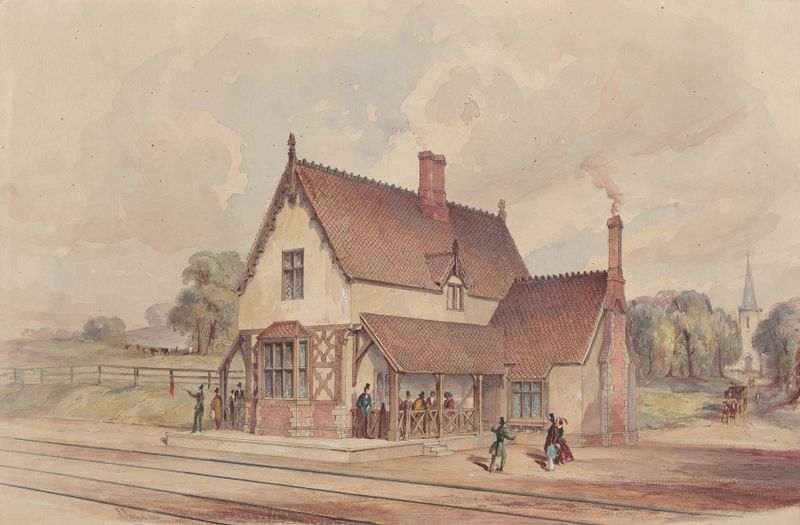
More Architecture Art
Browse all →
The statue of Liberty
Frédéric Auguste Bartholdi

View of Houses in Delft, Known as ‘The Little Street’
Johannes Vermeer

View of Houses in Delft, Known as ‘The Little Street’
Johannes Vermeer

The Cathedral in Rouen. The portal, Grey Weather
Claude Monet

The yellow house
Vincent van Gogh

The Church in Auvers-sur-Oise, View from the Chevet
Vincent van Gogh