United States Steamer Kearsage Leaving Boston Harbor — History & Facts
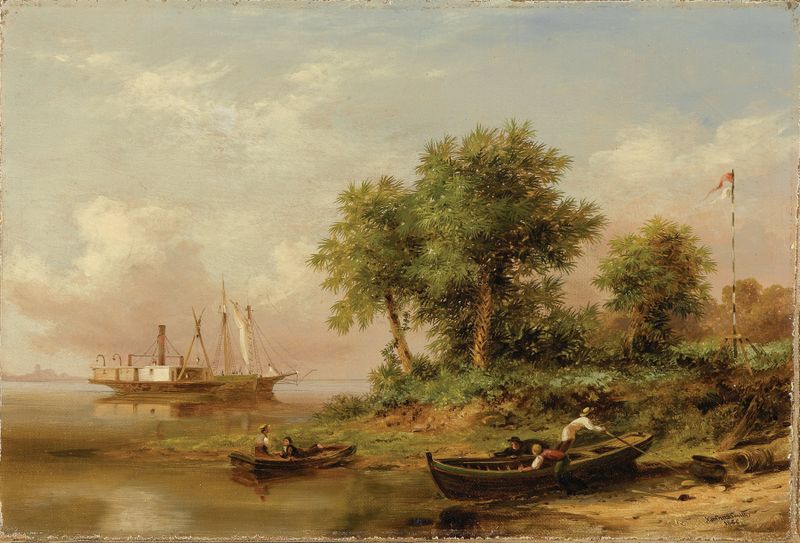
In this stark reflection on decay, a vessel stands resolute against the passage of time, echoing the relentless march of history. Focus on the powerful silhouette of the Kearsage, poised against a backdrop of muted blues and grays. The ship's hull, rendered with precision, captures both its proud functionality and the inevitability of rust and wear. Notice how the soft stroke of the waves reflects the ship’s sturdy form, yet hints at the waters’ unyielding nature, suggesting the fragility of human creations in the face of relentless time.
The distant horizon bleeds into the sky, where the muted sunlight casts a somber glow over the scene, evoking a sense of melancholy. Within the composition lies a tension between the grandeur of the ship and the encroaching decay. The sharp lines of the steamer contrast strikingly with the soft, flowing waters, drawing attention to the inevitable decline that follows even the most formidable constructs. Smith's deliberate choice of color—washed-out hues mingling with gray—serves as a reminder of the ephemeral nature of existence, where even the mightiest vessels are subject to the ravages of time and nature.
The interplay of light and shadow on the ship's surface reinforces this theme, giving the viewer a moment to ponder what it means to navigate the passage of life. In 1869, Xanthus Russell Smith painted this scene as a budding artist amidst a nation grappling with the consequences of the Civil War. Straddling the worlds of realism and romanticism, he sought to capture the essence of American maritime strength while alluding to the decay inherent in life itself. This work reflects not only a personal vision but also a broader commentary on the fleeting nature of triumphs and the persistent shadow of history.