Venus and Cupid — History & Facts
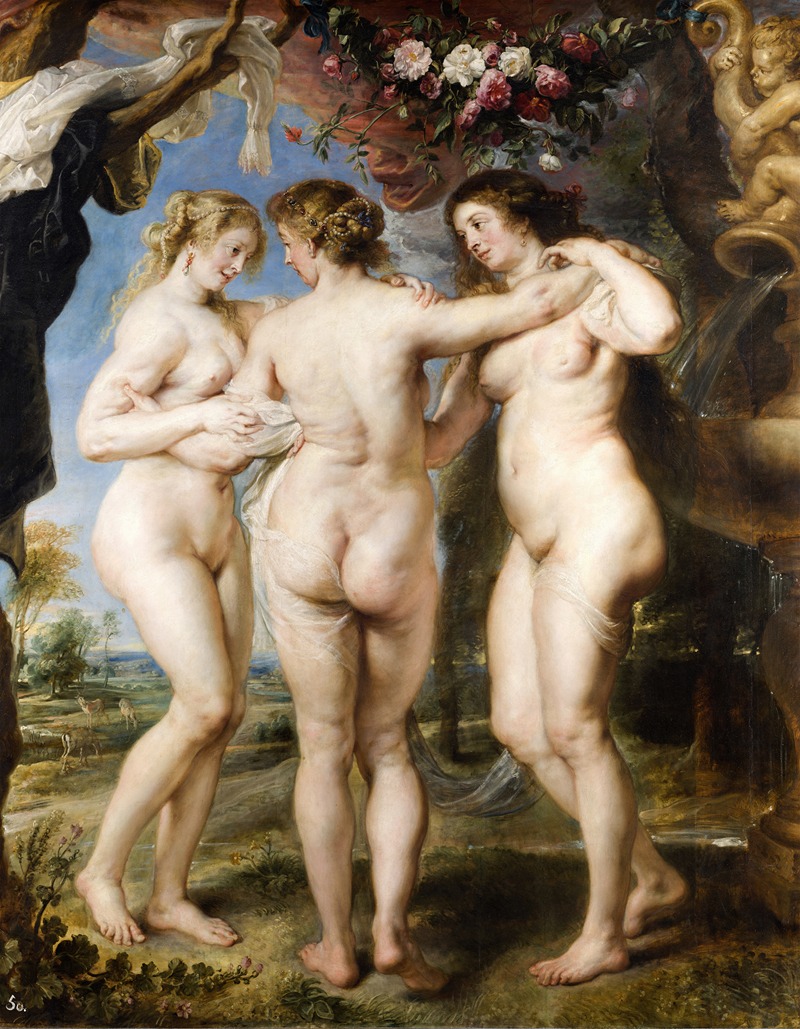
Can beauty exist without sorrow? In Venus and Cupid, the delicate intertwining of affection and melancholy invites a profound examination of this question. Focus first on the tender embrace at the heart of the composition. The figures of Venus and her son Cupid occupy the center, their bodies illuminated by a soft, ethereal light that highlights their flawless forms. The rich, warm colors of Venus’s drapery contrast with Cupid’s pale skin, amplifying their emotional connection.
Notice the intricate details in their expressions—the subtle smile on Venus’s lips, laced with an underlying sadness, and the curious gaze of Cupid, who seems aware of the complexities of love and desire. In this work, the artist captures the tension between joy and sorrow, evoking the bittersweet nature of maternal love. The presence of flora surrounding them symbolizes the beauty of love, yet it also hints at the transience of such moments. The delicate flowers can be seen as a reminder that beauty fades, much like fleeting youth.
This juxtaposition of innocence with an awareness of loss creates a poignant dialogue within the artwork, inviting viewers to reflect on their own experiences of love. Luca Cambiaso painted Venus and Cupid around 1570 during a period of great artistic flourishing in Italy. Based in Genoa, Cambiaso was heavily influenced by the Mannerist movement, which sought to elevate emotional expression through exaggerated forms and compositions. At this time, the art world was engaged in exploring complex human emotions, marking a significant shift from the idealism of the Renaissance, where Cambiaso found his unique voice, harmonizing classical beauty with layers of emotional depth.