View of Bratislava — History & Facts
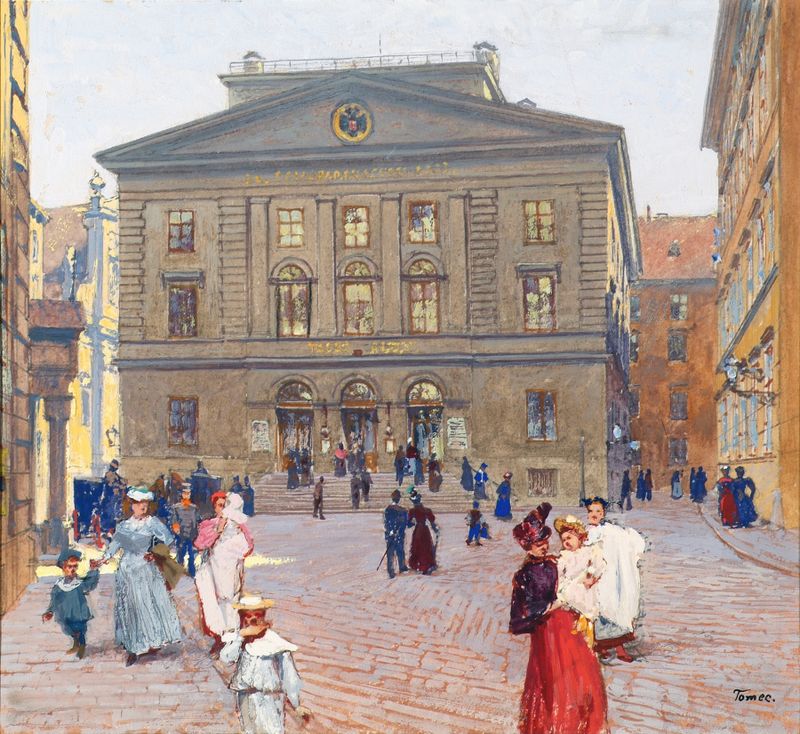
Can paint confess what words never could? In View of Bratislava, the artist captures an ephemeral moment of longing, evoking a sense of grief that lingers in the air like heavy clouds before a storm. Look to the left at the muted tones of the sky, where soft grays mingle with whispers of blue, suggesting an impending twilight. Notice how the structures of the city rise against this delicate backdrop — each building rendered with a tender touch that seems to echo their histories. The composition guides your gaze through the gentle undulations of the landscape, leading you toward the horizon where the distant hills softly fade.
This use of color and brushwork reflects not just the physicality of the place, but the weight of memory intertwined with the scene. In this artwork, contrasts abound; the vibrancy of the city pulsates with life, yet the overarching grayness speaks to an underlying sorrow. There is a subtle tension between the lively rooftops and the ominous sky, a visual representation of hope caught within despair. Each stroke hints at the artist’s personal narrative, perhaps a longing for a home forever altered by time and loss.
The distant river, shimmering yet restrained, symbolizes the passage of time and memories that flow through Bratislava, bittersweet and haunting. Jindřich Tomec painted View of Bratislava in 1925 during a time of cultural awakening in Central Europe. Having returned to his homeland after studying abroad, he found himself grappling with both nostalgia and the realities of a world reshaped by war. The interwar years were a fertile ground for artistic exploration, as many sought to capture the essence of their surroundings while confronting the complexities of identity and memory.