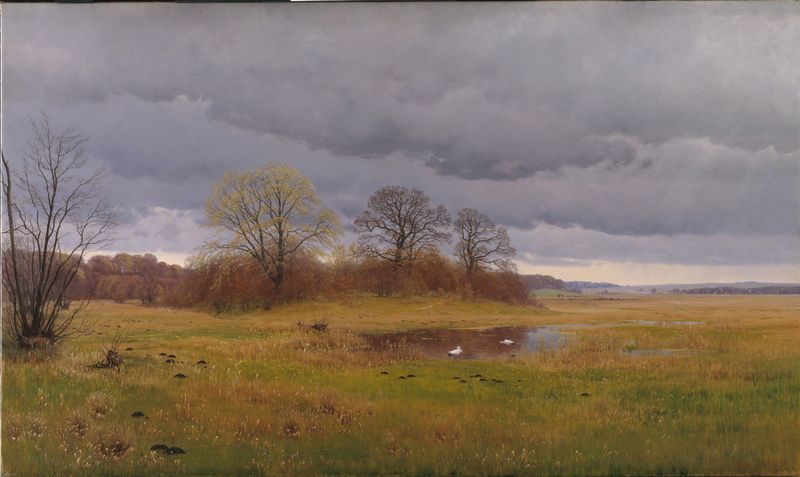
View of Pårup Moors near Silkeborg, Jutland — History & Facts
In the tranquil embrace of nature, how does one capture the ephemeral beauty of a moor? The question reverberates through the very essence of this artwork, inviting viewers to lose themselves in its illusion. Look to the center of the canvas, where the still waters of the moors reflect a world both real and dreamlike. The artist employs a palette of gentle greens and warm browns, verdant grasses intertwining with the soft, golden light of the setting sun. Each stroke seems deliberate yet spontaneous, as if the landscape itself breathed life into the canvas.
Notice the delicate play of light across the water’s surface, a shimmering veil that blurs the boundaries between sky and earth, evoking a sense of serenity and introspection. Beneath the surface tranquility lies a contrast between the stillness of the water and the subtle movement of the surrounding vegetation. The grass sways gently, hinting at a breeze that can't be felt but is imagined, creating a tension that speaks to the passage of time. The moors, often cast as desolate, are transformed into a contemplative space, embodying both solitude and beauty.
This duality reflects the artist's understanding of illusion—how nature can appear both vivid and intangible, a fleeting moment preserved forever. In 1868, Hans Friis was deeply engaged with capturing the Nordic landscapes that defined his early career. Painting near Silkeborg, amidst a burgeoning romantic movement, he sought to express the emotional resonance of the natural world. The mid-19th century in Denmark was a period of national identity exploration, and Friis’s work stands as a testament to this connection between land, identity, and the painter’s own evolving vision.