View of Svaneke — History & Facts
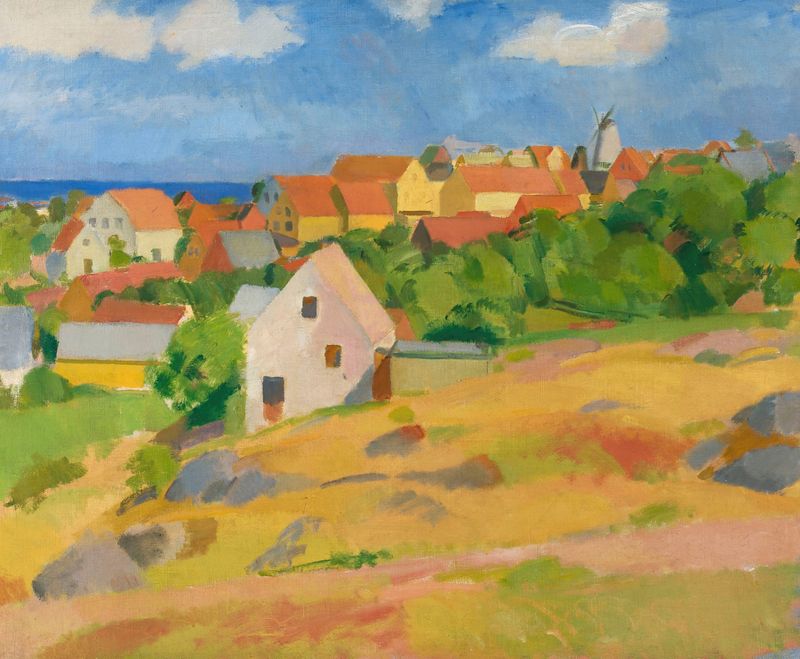
What if beauty was never meant to be finished? In the tranquil embrace of View of Svaneke, the viewer is invited into a moment suspended in time, where faith in nature's subtleties is palpable and profound. Look to the left, where the soft blue expanse of the sky fades into the whisper of dawn. The brushstrokes are fluid, capturing an ethereal light that dances across the landscape. Now shift your gaze to the foreground, where quaint houses dot the shoreline, painted in ochres and muted pastels.
Notice how the gentle contours of the hills lead your eye toward the horizon, creating a harmonious balance between earth and sky, and evoking a sense of serenity that feels almost transcendent. In this scene, contrasts abound—a delicate tension between the solidity of the structures and the ephemeral nature of the surrounding water. The scene brims with faith, not just in the beauty of the place, but in the belief that such moments can endure. Each element, from the textured clouds to the shimmering reflections in the water, speaks of a world that exists in an eternal state of becoming, yet never fully realized.
It is an invitation to contemplate what lies beyond the visible. Created around 1919 in Denmark, this work emerged during a period of significant change and upheaval, both personally for the artist and within the broader art world. Isakson was exploring new stylistic approaches, influenced by movements seeking to capture the essence of modern life. The post-World War I landscape bore the weight of collective trauma, and in response, artists like him sought solace in nature's simplicity and enduring beauty, embodying a faith that art can heal and inspire.