View over Gudhjem — History & Facts
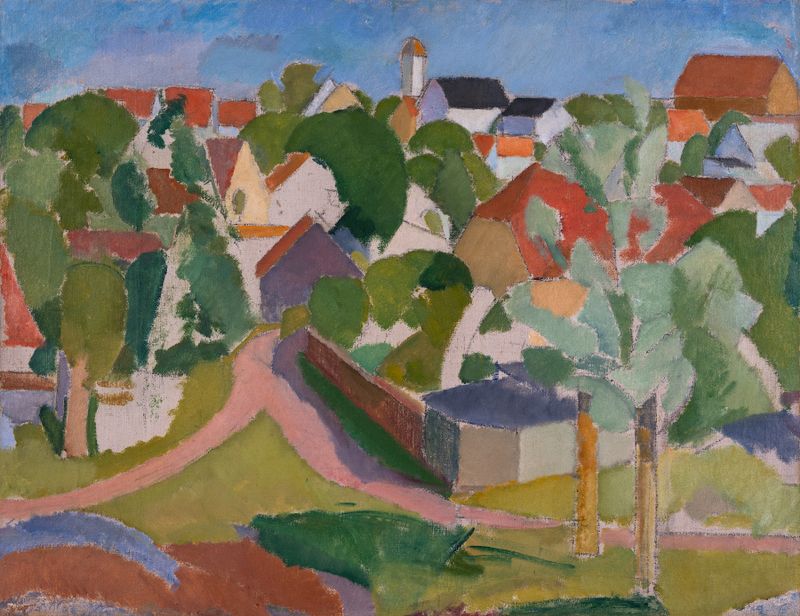
Could beauty survive in a century of chaos? In View over Gudhjem, Karl Isakson invites us to ponder just that as we gaze upon a tranquil coastal scene that belies the tumult of its time. Look to the horizon, where the vibrant blues of the sea merge seamlessly with the sky. Notice how the artist deftly captures the play of light on the water, employing brilliant strokes of white to suggest the gentle movement of waves. The quaint village of Gudhjem nestles against the cliffs, its red-roofed buildings bathed in warm sunlight, inviting our eyes to trace the undulating lines of the landscape that flow down towards the shore.
The careful placement of each element reflects a harmony that feels both grounded and ethereal. Within this serene vista lies an exploration of contrast—between the softness of the surroundings and the latent unease of the world beyond. The stillness of the scene suggests a fleeting moment of peace, yet the brushwork conveys an undercurrent of tension, as if the landscape itself is holding its breath, aware of the void lurking just beyond its borders. Each brushstroke reveals a story of resilience, a stubborn refusal to yield to the chaos, presenting beauty as both fragile and enduring. In 1921, Isakson was in his native Denmark, a time when the aftermath of World War I still cast a long shadow over Europe.
This was a period of introspection and renewal in the art world, as artists sought new expressions in response to the horrors they had witnessed. Immersed in a quest for emotional truth, Isakson's work emerged as a testament to the power of beauty to persist even amidst uncertainty.