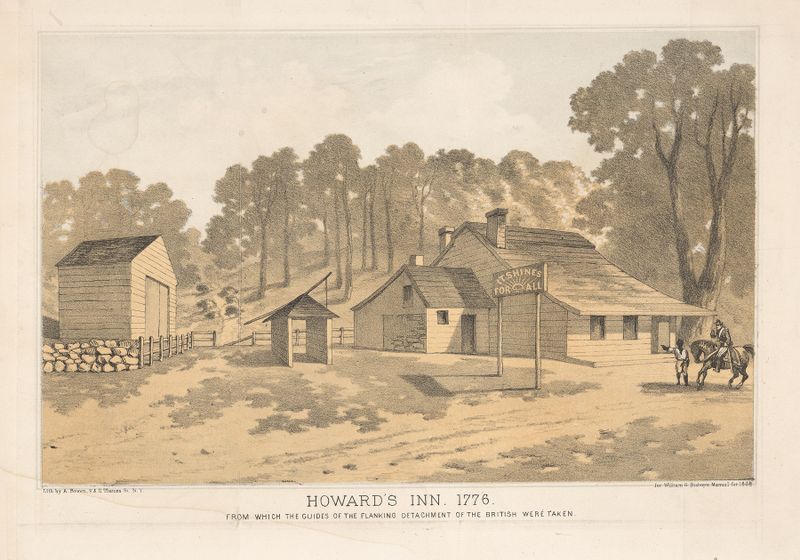
View of the house in New Utrecht L.I. in which Gen. Nathanial Woodhull died of his wounds in 1776. — History & Facts
Can beauty exist without sorrow? In the quiet stillness of a landscape, a haunting legacy emerges, tethering history to the present. Look to the center of the canvas, where a modest house stands against a backdrop of soft, rolling hills. The gentle hues of the sky—pale blues and warm beige—encase the structure, while shadows play delicately upon the ground, hinting at a subtle breeze. Notice how the artist employs smooth brushstrokes to create a sense of tranquility, yet within this calm, the house itself seems burdened, carrying the weight of its historical significance. The composition reveals a poignant contrast between the beauty of nature and the sorrow of loss.
The serene setting belies the tragic events that unfolded within its walls, as the legacy of General Nathanial Woodhull resonates through the landscape. Small details, such as the overgrown grass and a solitary tree, suggest neglect, a metaphor for the overlooked sacrifices of those who came before us. Here, the house stands not just as a physical structure but as a silent witness to the trials of war and the enduring pain of memory. In 1866, the artist was immersed in a post-Civil War America, grappling with a collective memory of conflict and the search for identity.
Painting this scene in New Utrecht, Brown aimed to immortalize a site of historical resonance, reflecting a broader artistic trend where landscapes served as vessels for remembrance. His work invites viewers to contemplate the delicate interplay between beauty and the shadows of history that linger in its wake.