Views in England, Scotland, and Wales: Tour in Scotland: Landscape with Stream — History & Facts
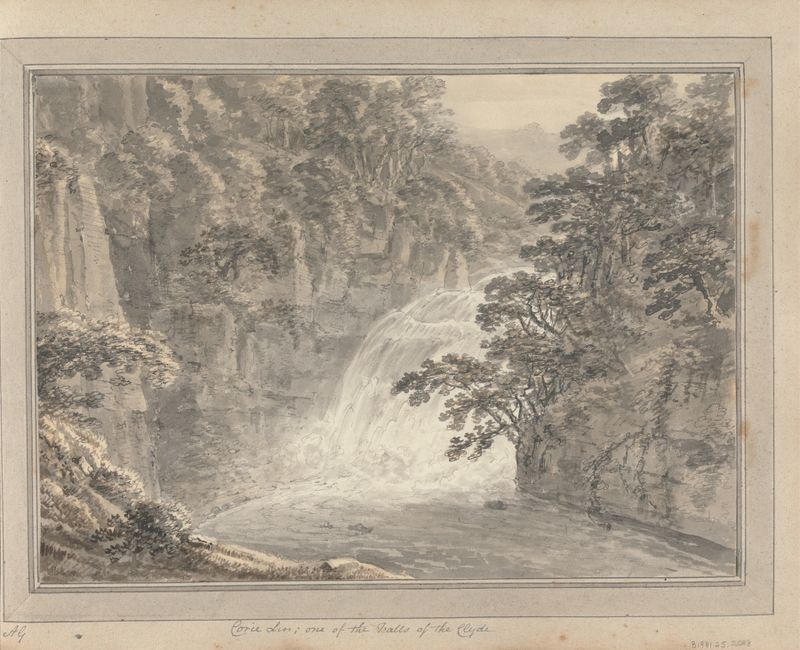
Could beauty survive in a century of chaos? The tumultuous nature of the early 19th century challenges us to find solace in the natural world, a theme poignantly explored by the artist in this serene landscape. Focus on the gentle curve of the stream that meanders through the composition, drawing your eye from the foreground into the distant horizon. Notice how the vibrant greens of the rolling hills contrast beautifully with the soft, muted browns of the soil, suggesting a harmonious relationship between land and water. The artist employs delicate brushwork to capture the play of light on the surface of the stream, creating a shimmering effect that evokes a sense of tranquility amid the restless world outside. Within this peaceful scene lies a complex interplay of rebirth and renewal.
The stream itself becomes a symbol of life, flowing steadily despite the chaos surrounding it. Look closer at the clusters of flowers dotting the banks; they offer a glimpse of hope and resilience—an assertion that beauty can thrive even in uncertain times. The juxtaposition of the tranquil landscape against the looming mountains in the distance hints at the challenges that lie ahead, reminding us that nature, while enduring, is also a reflection of human emotion. Amos Green created this work in 1802, during a period of significant change in Britain, marked by the aftermath of the French Revolutionary Wars and the onset of industrialization.
At this time, artists were exploring themes of nature as both an escape and a battleground for the soul, seeking to capture the essence of landscapes that would soon be threatened by urbanization. This piece highlights Green's commitment to portraying the inherent beauty of the British countryside, even as the world around it began to evolve dramatically.