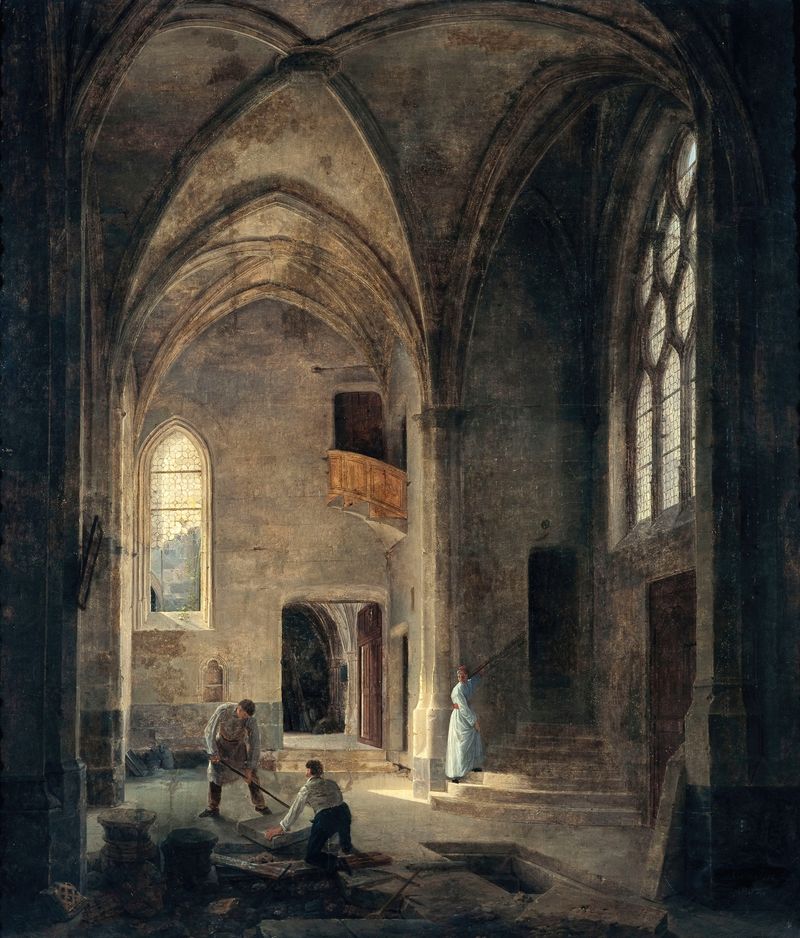
Vue intérieure de l’église Saint-Benoît-le-Bestouné; la nef méridionale. — History & Facts
Is this a mirror — or a memory? In Vue intérieure de l’église Saint-Benoît-le-Bestouné, the viewer is drawn into a sacred space that stirs whispers of the past, evoking fleeting moments of contemplation and reverence. Look to the center, where the nave stretches dramatically into the distance, drawing our gaze along the architectural lines. Notice how the soft light filters through the stained glass, casting ethereal colors onto the stone floor, and illuminating the intricate details of the altar. Each brushstroke captures the textured surfaces of the walls, contrasting the solidity of the architecture with the delicate play of light, creating a sense of depth that invites introspection. In this work, an interplay between permanence and transience emerges.
The church signifies a sanctuary against the insignificance of time, yet the dim corners remind us of the fleeting nature of existence. The light, both illuminating and shadowing, reflects a duality of hope and despair — a reminder that every moment is both sacred and ephemeral, urging us to acknowledge our mortality in the face of enduring beauty. Louis Courtin painted this piece in 1838 during a period marked by romanticism in France, where artists sought to capture emotional depth and the sublime. Nestled within the tranquil confines of a church, he explores themes of spirituality and the passage of time, providing a reflective commentary on the era’s quest for meaning amidst the rapid changes of the modern world.