Waldpartie bei Mödling — History & Facts
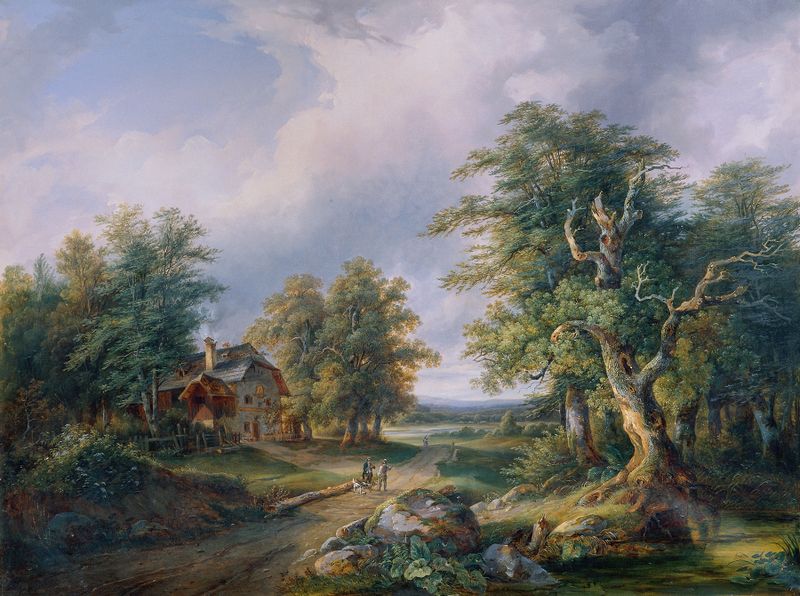
Could a single brushstroke hold eternity? Within the lush greenery of Waldpartie bei Mödling, a world unfolds, where every hue and texture reflects a moment suspended in time. Look to the foreground at the delicate interplay of light and shadow; notice how the soft greens of the foliage give way to dappled sunlight, creating a serene pathway that invites exploration. The brushwork is both meticulous and spontaneous, offering a sense of movement as if the wind gently stirs the trees. The contrast between the vibrant greenery and the cool shadows provides depth, while the horizon glows with a promise of warm sunlight. The composition speaks of harmony and solitude, evoking a contemplative mood.
Hidden among the leaves, tiny details—a solitary flower, a fluttering bird—hint at life and connection, suggesting that nature is both a sanctuary and a reflection of our inner selves. This duality invites viewers to consider their own experiences with solitude and serenity, drawing parallels between the tranquil forest and the human spirit. In 1850, Josef Altenkopf painted this scene during a time when the Romantic movement was flourishing. His artistic pursuits were influenced by the natural beauty surrounding Mödling, as well as the evolving appreciation for landscape painting.
This was a pivotal period in the art world, where artists sought to capture the essence of nature, reflecting deeper emotional and philosophical themes that resonated with the societal shifts of his time.