Winter in Germany — History & Facts
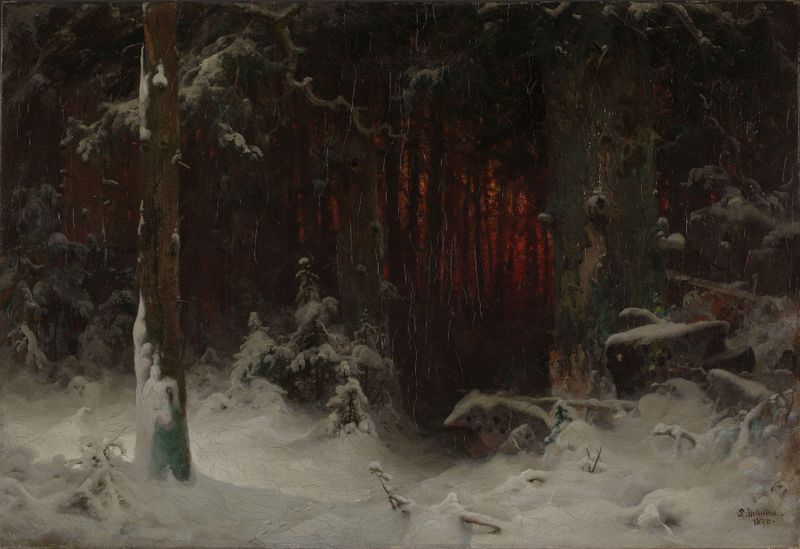
Can paint confess what words never could? In Winter in Germany, the canvas vibrates with a palpable sense of movement, evoking the silent whispers of a season's chill and the life that persists within it. Look at the center, where a thawing landscape breathes softly under a blanket of snow, revealing the tender greens and browns of early spring peeking through. The brushstrokes twist and turn, capturing the fleeting essence of nature's transition. Pay attention to the interplay of light—it dances across the surface, illuminating the trees with an ethereal glow that contrasts sharply with the cool, muted blues surrounding them.
Each stroke suggests a gentle breeze, inviting you to imagine the subtle sounds of melting ice and rustling leaves. Beneath the serene beauty lies a deeper tension—the coexistence of winter’s grasp and the awakening of life. Notice how the dark, heavy clouds loom above, casting shadows that remind us of lingering cold, while below, the vibrant hints of spring symbolize hope and renewal. This juxtaposition resonates with a sense of anticipation, embodying the struggle between stillness and motion, despair and rebirth. Ludvig Munthe painted Winter in Germany in 1869 during a transformative period in European art.
Living in Germany, he was influenced by the Romantic movement, which sought to express emotion and the sublime in nature. This work reflects his mastery of capturing ephemeral moments, just as he was transitioning into a new phase in his artistic career, moving away from traditional forms to embrace a more personal and evocative style.