Winter Landscape — History & Facts
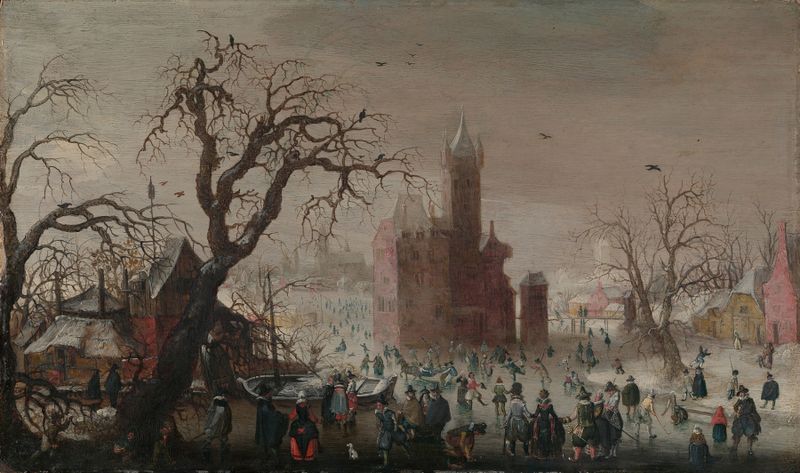
In the stillness of Winter Landscape, the artist captures the essence of fleeting moments, preserving the whispers of nature as they slip into memory. Here, a delicate balance of snow-draped trees and a muted palette evokes a sense of tranquil legacy, inviting viewers to reflect on their own passages through time. Look closely at the foreground, where gentle curves of snow intermingle with sparse, dark branches. Notice how the light dances softly upon the snow, illuminating the scene with an ethereal glow while shadowy undercurrents suggest hidden depths beneath the surface.
The palette, a blend of soft whites and muted browns, creates a serene yet somber ambiance, guiding the gaze from the foreground into the depth of the wintry landscape, where distant hills fade into the horizon. This painting speaks to contrasts—the quiet beauty of the winter scene versus the stark reminder of nature's impermanence. The delicate interplay of light and shadow hints at the passage of time, while the stillness captures both serenity and the melancholy of change. Each brushstroke seems to whisper of a legacy that transcends the immediacy of the moment, raising questions about what we choose to remember and what is inevitably lost to time. During the early 17th century, Christoffel van den Berghe was immersed in the Northern Renaissance art movement, flourishing in the Netherlands.
Painting Winter Landscape around 1615-1620, he navigated a world experiencing rich artistic evolution. This period was characterized by a growing interest in realistic landscapes, reflecting the intricate relationship between nature and human emotion, setting the stage for how landscapes would be interpreted in art for generations to come.