A Foggy Day on the Hudson — History & Facts
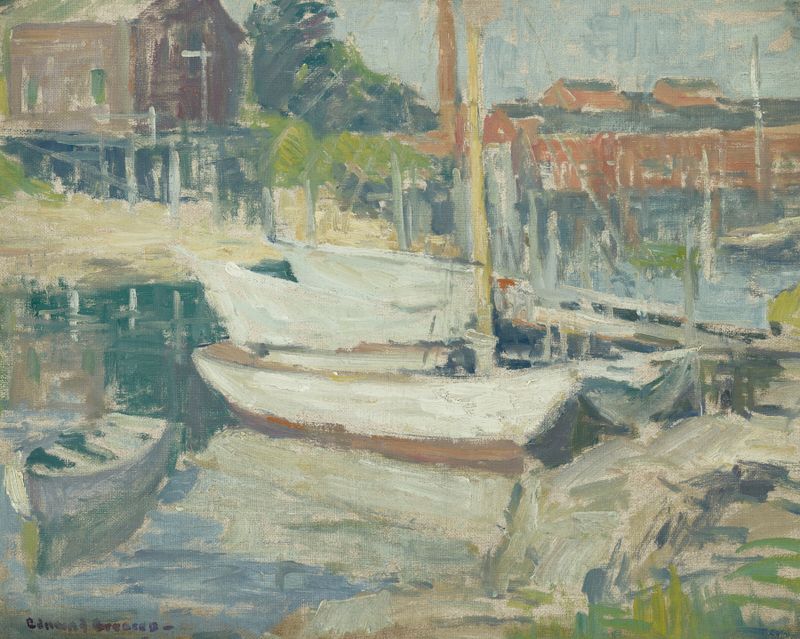
Can beauty exist without sorrow? In A Foggy Day on the Hudson, the artist presents us with a tranquil scene that wades through a veil of melancholic reflection, where the gentle obscurity of fog suggests something both serene and elusive. Look to the lower right at the softened outlines of boats, their forms barely emerging from the mist. Greacen’s delicate brushwork creates an ethereal quality, as muted blues and grays blend harmoniously, while subtle touches of white evoke the soft embrace of fog. The composition draws the eye upward towards the vast, blurred skyline, where the buildings dissolve into the hazy ether, inviting contemplation about the connection between nature and urbanity. In this hazy embrace, contrasts abound—between the tangible world of the boats and the intangible fog that surrounds them, symbolizing the transient nature of life and the weight of memory.
The muted palette reflects an emotional undercurrent, suggesting an introspective moment where one confronts both the beauty and sadness inherent in existence. The fog serves as a metaphor for the obscured visions we carry, clouded by past experiences yet still offering a sense of peace. Greacen created this work in 1913, amidst a burgeoning American art scene that was increasingly embracing Impressionism. At this time, he was exploring the evocative power of color and light, capturing landscapes that resonated with a sense of place and reflection.
The early 20th century marked a period of transition in both his life and the world, as industrialization transformed the American landscape, reflecting the tension between nature and modernity.