
A ruined classical temple of the Tuscan order with figures — History & Facts
Did the painter know this moment would outlive them? In the wake of loss and the passage of time, the echoes of a grand past haunt every stone of this forsaken temple. Direct your gaze to the decaying columns on the left; their rough surfaces tell stories of forgotten glory, draped in shadows that deepen the sense of abandonment. The muted greens and browns of the overgrown foliage contrast starkly with the crumbling white marble, emphasizing both the beauty and the tragedy of decay. Notice how the artist employs light to dance delicately across the scene, highlighting not just the architecture but the silhouettes of the figures, who appear to wander aimlessly among the ruins, tragically unaware of their surroundings. Within this desolate temple, the mingling of grief and nostalgia manifests profoundly.
Each figure, lost in thought, serves as a poignant reminder of the ephemerality of human achievement against nature’s relentless march. There is a subtle tension between the permanence of the stone and the vulnerability of the wanderers, suggesting an existential reflection on legacy and loss. The encroaching greenery symbolizes nature reclaiming its territory, evoking feelings of mourning for the past that can never be retrieved. In the mid-17th century, during a period of Baroque flourishing, Giovanni Ghisolfi created this work in Milan, a city he called home.
The art scene was vibrant, with a focus on dramatic compositions and elaborate scenery. This piece reflects Ghisolfi’s fascination with ruins, a motif increasingly explored by artists in response to a world recovering from the ravages of conflict and the search for meaning in a changing landscape.
More Artworks by Giovanni Ghisolfi
Browse all →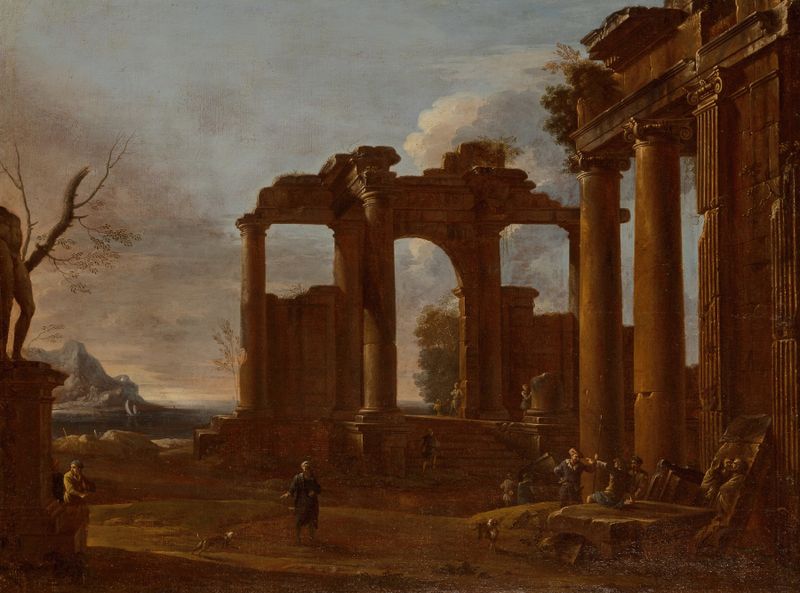
More Architecture Art
Browse all →
The statue of Liberty
Frédéric Auguste Bartholdi

View of Houses in Delft, Known as ‘The Little Street’
Johannes Vermeer

View of Houses in Delft, Known as ‘The Little Street’
Johannes Vermeer

The Cathedral in Rouen. The portal, Grey Weather
Claude Monet

The yellow house
Vincent van Gogh

The Church in Auvers-sur-Oise, View from the Chevet
Vincent van Gogh