
Abend nach der Schlacht bei Wörth — History & Facts
In a world often clouded by the aftermath of conflict, the delicate balance between innocence and destruction is a profound theme that emerges in many works of art. How do we navigate the ruins, and what stories do they tell us about humanity? Look to the center of Abend nach der Schlacht bei Wörth, where the remnants of battle lay across the ground, softened by the gentle twilight. The palette transitions from the harsh tones of war to the warm hues of a fading day, inviting contemplation amidst the chaos.
Notice how the light delicately caresses the fallen figures, emphasizing their fragility and vulnerability. The composition draws the eye inward, creating a poignant juxtaposition of serene twilight against the visceral reality of the battlefield. Delve deeper into the emotional landscape of the painting, where the stillness contrasts starkly with the echoes of conflict. The noble horses, though weary and battered, retain a sense of dignity that speaks to a lost innocence.
In the background, the figures of soldiers, some attending to their mounts while others lie still, evoke a sense of mourning—not for the fallen alone, but for the innocence lost amidst the brutality. This tension transforms the scene into a meditation on human endurance and the aftermath of violence. Franz Adam created Abend nach der Schlacht bei Wörth in the aftermath of the Franco-Prussian War, a time when the realities of war weighed heavily on the European consciousness. Working predominantly in Munich, Adam focused on depicting military life and battles, capturing both the valor and the tragedies of his subjects.
This painting reflects not just the historical moment but also Adam's evolving perspective as he sought to convey the complex interplay between valor, loss, and the enduring spirit of those affected.
More Artworks by Franz Adam
Browse all →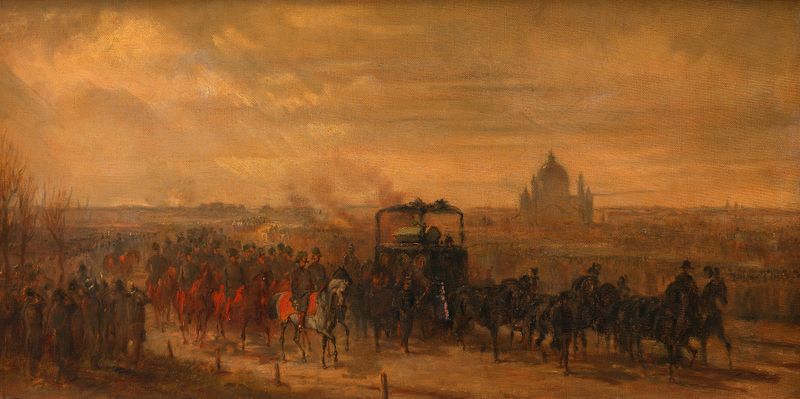
More Historical Art
Browse all →
The Night Watch Militia Company of District II under the Command of Captain Frans Banninck Cocq
Rembrandt van Rijn

Lincoln Memorial
Henry Bacon

The Third of May 1808
Francisco de Goya

Isaac and Rebecca, Known as ‘The Jewish Bride’
Rembrandt van Rijn

The Charge of the Mamelukes (1814)
Francisco de Goya

De vier ruiters van de apocalyps
Albrecht Dürer