Beach Scene, Newport — History & Facts
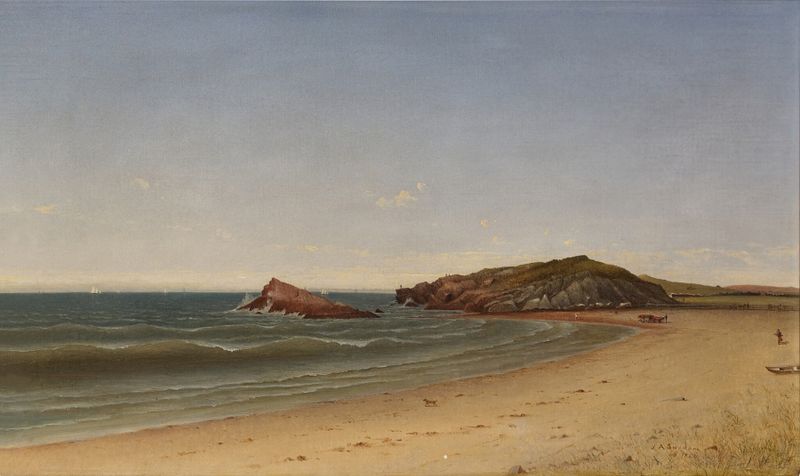
Who listens when art speaks of silence? In Beach Scene, Newport, a moment suspended in time invites viewers to contemplate the dialogue between stillness and the essence of truth. Look to the center of the canvas, where a gentle shoreline meets the surf, embracing the earth in a soft embrace. The delicate strokes of white paint depict waves lapping at the sandy beach, while rich blues and warm creams evoke the ephemeral beauty of a summer day. The careful play of light dances across the water’s surface, casting reflections that ripple with life, drawing the eye to the horizon where sea and sky merge. This work captures more than just a tranquil day at the beach; it speaks to contrasts of nature’s beauty and human insignificance.
Notice the few figures scattered along the shore, their smallness against the vastness of the sea hinting at a profound solitude. The quiet interaction between the vibrant blues of the ocean and the muted earth tones of the sand suggests a deeper harmony present in moments of stillness, revealing layers of emotion hidden beneath the surface. James Augustus Suydam created this piece in the summer of 1860, a time when American landscape painting was gaining popularity as a genre. As he painted in Newport, he was influenced by the Hudson River School's exploration of light and atmosphere, contributing to a broader conversation about nature and its representation in art.
In this context, Beach Scene, Newport stands as a testament to both personal expression and the evolving landscape of American art.