
Blick auf einen Kirchenvorplatz — History & Facts
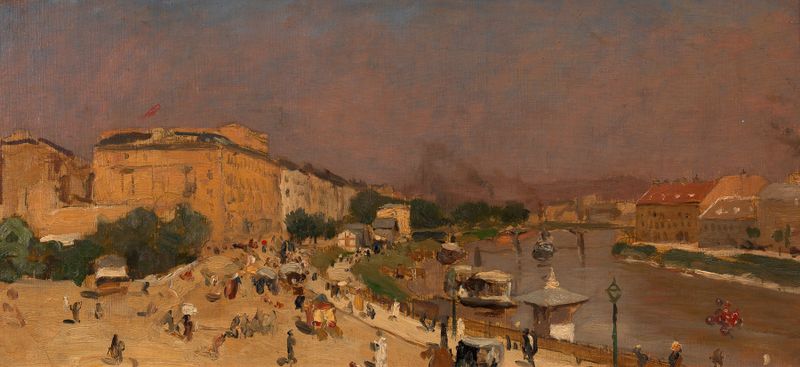
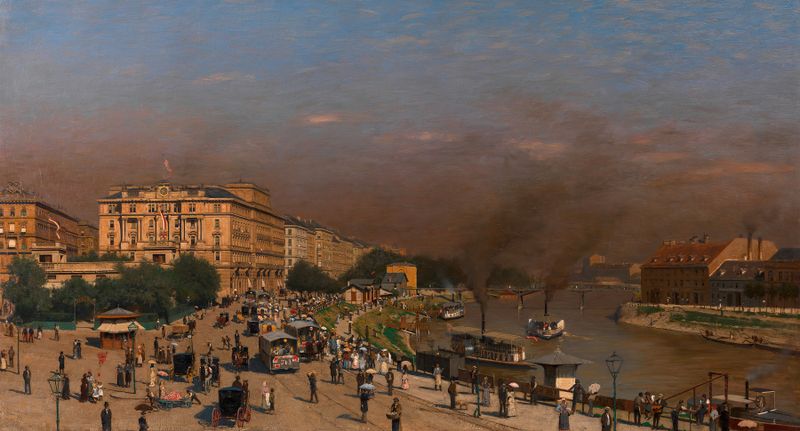
Could beauty survive in a century of chaos? In a world marked by turbulence, one finds solace in the stillness of a moment meticulously captured on canvas. Focus on the foreground where the quaint church stands, its weathered facade a testament to time. Notice how the warm hues of the building contrast against the cool, shadowed cobblestones, inviting you to step closer. The artist employs soft brushstrokes to suggest the texture of the architecture, while dappled light spills from the upper corner, illuminating fragments of life in delicate shades.
Your eyes are drawn to a pair of figures, seemingly lost in contemplation, embodying the quietude of the space. Delve deeper into the scene, where the interplay of light and shadow reveals emotional tensions. The church’s serene presence stands juxtaposed with the hints of urban life surrounding it—perhaps a reminder of the chaos lurking just beyond the frame. The loose brushwork lends an ephemeral quality, suggesting that beauty itself might be fleeting, yet eternally significant.
These details whisper of resilience and the human urge to find harmony amid disorder. In this unnamed period, Wilhelm Bernatzik painted this work, likely influenced by the socio-political upheavals of his time. Living in the early to mid-20th century, the artist navigated the complexities of a world grappling with war and transformation. His art reflects a desire to capture moments of peace and beauty as a counterbalance to the tumultuous events unfolding around him.
More Artworks by Wilhelm Bernatzik
Browse all →
More Architecture Art
Browse all →
The statue of Liberty
Frédéric Auguste Bartholdi

View of Houses in Delft, Known as ‘The Little Street’
Johannes Vermeer

View of Houses in Delft, Known as ‘The Little Street’
Johannes Vermeer

The Cathedral in Rouen. The portal, Grey Weather
Claude Monet

The yellow house
Vincent van Gogh

The Church in Auvers-sur-Oise, View from the Chevet
Vincent van Gogh