
Champigny Décembre 1870 — History & Facts
When did color learn to lie? In the hands of the skilled, it becomes a veil, hiding truths in the shadows while illuminating the profound. Look to the foreground, where the weary soldiers rest, their fatigue palpable through the muted palette of earthy browns and grays. The subtle interplay of light highlights the textures of their worn uniforms and the frost-kissed terrain. Notice how Detaille captures the harsh reality of winter in the meticulously painted snow, each flake seemingly whispering a story of endurance against the biting cold. Yet, beneath this wintery landscape lies a deeper metaphor of resilience and the human spirit.
The contrast between the soldiers' somber expressions and the pristine white of the snow evokes a poignant sense of hope amidst despair. Look closer at the horizon, where a faint light seems to struggle against the encroaching dusk, symbolizing the flickering flame of courage even in the darkest of times. In 1879, while living in Paris, Detaille painted this reflective scene post-Franco-Prussian War. The circumstances surrounding this period were steeped in national strife, and the artist sought to depict the true essence of soldier life, drawing from personal experiences and the collective memory of conflict.
It was a time when realism began to anchor itself firmly in art, capturing not just beauty, but the rawness of human existence.
More Artworks by Jean-Baptiste Édouard Detaille
Browse all →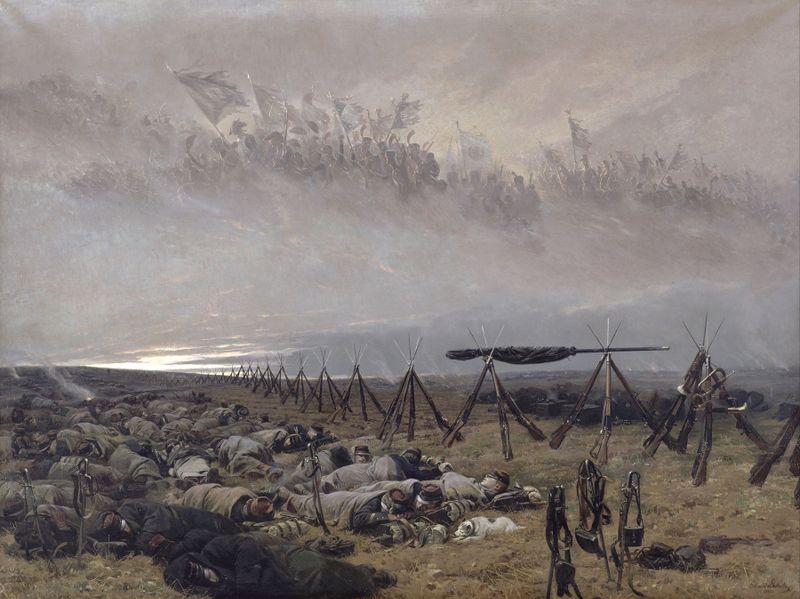
More Historical Art
Browse all →
The Night Watch Militia Company of District II under the Command of Captain Frans Banninck Cocq
Rembrandt van Rijn

Lincoln Memorial
Henry Bacon

The Third of May 1808
Francisco de Goya

Isaac and Rebecca, Known as ‘The Jewish Bride’
Rembrandt van Rijn

The Charge of the Mamelukes (1814)
Francisco de Goya

De vier ruiters van de apocalyps
Albrecht Dürer