
Christ preaching ('La Petite Tombe') — History & Facts
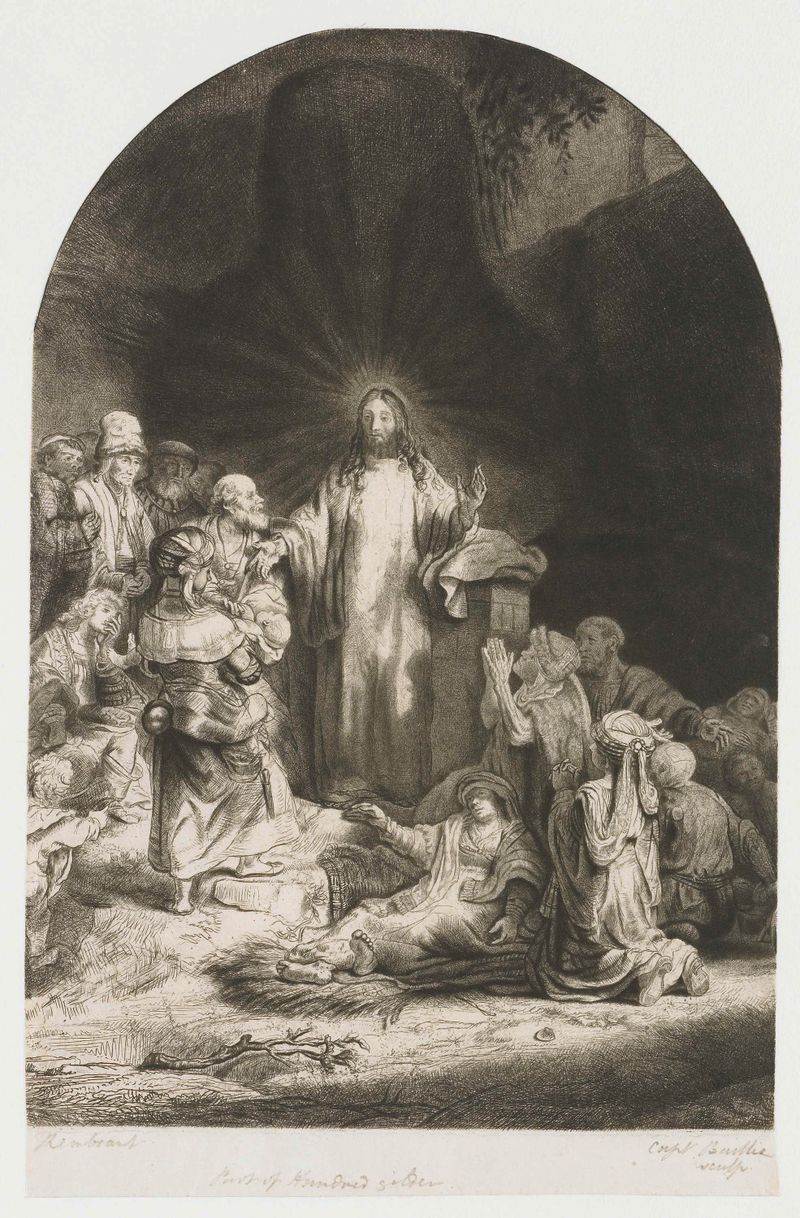
What secret hides in the quiet of the canvas? Rembrandt's Christ preaching ('La Petite Tombe') invites us to delve into the profound desire for connection and understanding that pulses beneath its surface. Gaze first at the figure of Christ, centrally positioned, his eloquent hand raised in a gesture of both authority and invitation. Notice how the soft, warm light spills over his form, illuminating the folds of his garment while casting deep shadows that envelop the faces of the eager listeners surrounding him. The intensity of their expressions—some rapt with attention, others lost in contemplation—draws the viewer into a moment of sacred communion.
The muted palette, composed primarily of browns and ochres, complements the scene’s gravity, enhancing the emotional weight that hangs in the air. As you absorb the expression of longing etched on each listener's face, consider the juxtaposition of light and shadow in the composition. The interplay signifies not just the physical presence of Christ, but the spiritual illumination he brings. This painting transcends mere depiction; it becomes a study of the human spirit's quest for deeper truths.
Each figure, whether in reverence or skepticism, embodies the universal yearning for enlightenment and profound connection to something greater than oneself. Rembrandt created this work around 1657, during a period marked by personal struggle and artistic evolution. Living in Amsterdam, he was navigating both financial difficulties and the loss of loved ones while simultaneously redefining his approach to light and narrative in painting. It was a time when the Baroque movement flourished, yet Rembrandt's intimate engagements with his subjects set him apart, ensuring his works resonate with raw human emotion even centuries later.
More Artworks by Rembrandt van Rijn
Browse all →
The Night Watch Militia Company of District II under the Command of Captain Frans Banninck Cocq
Rembrandt van Rijn

The Return of the Prodigal Son
Rembrandt van Rijn

The Hundred Guilder Print: the figures leaning on the wall in the centre left
Rembrandt van Rijn

The Hundred Guilder Print: the central piece with Christ preaching, the plate arched
Rembrandt van Rijn

Isaac and Rebecca, Known as ‘The Jewish Bride’
Rembrandt van Rijn
The Mill
Rembrandt van Rijn

The Sampling Officials of the Amsterdam Drapers’ Guild, Known as ‘The Syndics’
Rembrandt van Rijn

The return of the prodigal son
Rembrandt van Rijn
The Hundred Guilder Print: the central piece with Christ preaching, the plate arched
Rembrandt van Rijn

The Hundred Guilder Print: the man seen on the back in the lower left corner
Rembrandt van Rijn
More Religious Art
Browse all →The Return of the Prodigal Son
Rembrandt van Rijn

The Garden of Earthly Delights
El Bosco

Count Orgaz’ funeral
El Greco
The Hundred Guilder Print: the central piece with Christ preaching, the plate arched
Rembrandt van Rijn

The Descent from the Cross
Rogier van der Weyden
The return of the prodigal son
Rembrandt van Rijn