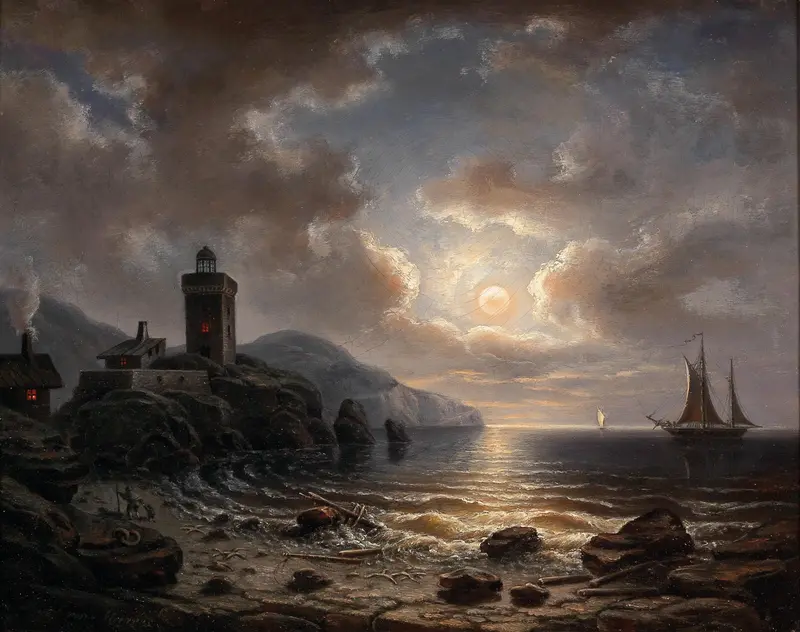
Coast at Night with Lighthouses — History & Facts
A restless moon commands the scene, its light caught and scattered by clouds that seem to move as you watch. The eye is drawn first to the luminous path it carves across the water, then to the two lighthouses whose red windows burn like watchful eyes on the rocky shore. The ship, sails furled, rides the uneasy surf, its dark hull almost merging with the night, while a smaller vessel glimmers in the distance—perhaps a promise, or a warning.
Every detail is charged with purpose: the smoke rising from the keeper’s cottage, the scattered debris on the shore, the wet gleam on the rocks. This is not a tranquil night, but one of vigilance and waiting, where the lights on land and sea must answer each other’s signals. Painted in 1869, Coast at Night with Lighthouses by Albert De Marees belongs to a moment when the dangers and romance of maritime travel fascinated both artists and their audiences. The 19th century saw a surge in coastal scenes, often commissioned by shipowners, merchants, or collectors drawn to the drama of navigation and the technological marvels of lighthouses.
While history has kept few traces of De Marees himself, his work stands in the tradition of those who captured the interplay of human ingenuity and nature’s unpredictability. This painting, now part of a 19th-century collection at Dorotheum, invites viewers to step into a world where every light on the horizon was both a hope and a warning—an invitation to linger in the moonlit uncertainty.