Conflagration at Night — History & Facts
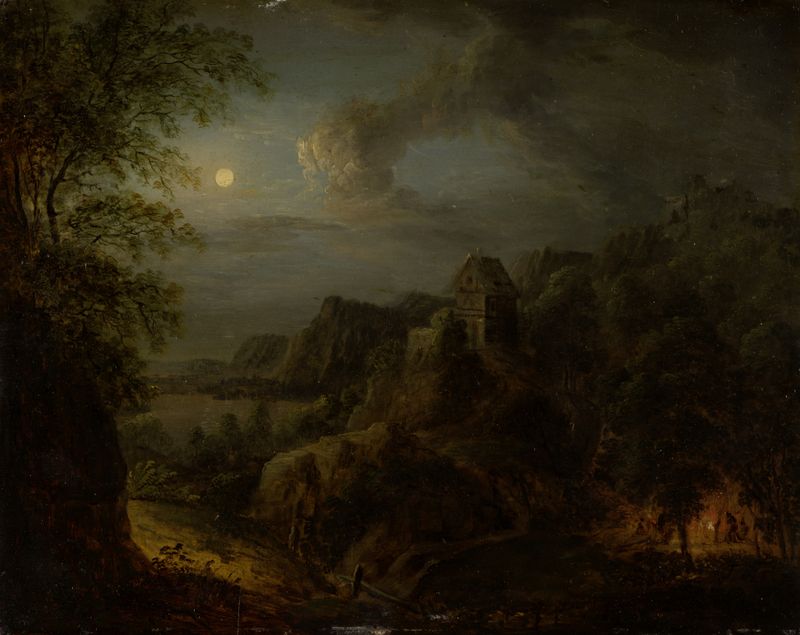
Can paint confess what words never could? In the flickering dance of flames, a tale of destruction and rebirth unfolds, capturing the viewer in its fiery embrace. Look to the foreground where the brilliant orange and red hues clash with the deep shadows lurking at the edges. The chaotic swirl of the fire, rendered with dynamic brushstrokes, draws the eye immediately to the heart of the conflagration. Notice how the light spills over the faces of the onlookers, their expressions etched with both awe and terror, each one a study in human vulnerability against the might of nature.
The painter’s palette contrasts the warmth of the blaze with the cool blues and grays of the night, creating a vivid tension that pulses through the canvas. Deeper still lies the contrast between devastation and renewal. The fire emerges as a dual symbol — both a harbinger of loss and a necessary force for rebirth. As the flames consume the structures, one can almost sense the air thick with possibility, the very essence of transformation.
Tiny details, like the way the smoke curls elegantly upwards or how the faces reflect a collective fear mingled with hope, suggest a profound commentary on the cyclical nature of existence and the resilience of the human spirit. Johann Georg Trautmann created this piece between 1762 and 1769 during a time of great change in the arts, as Enlightenment ideas began to challenge traditional forms. Living in Germany, he witnessed shifting ideologies that influenced the representation of emotion in art, striving to convey not just the visual reality but the deeper human experiences intertwined with it. In depicting such a volatile scene, Trautmann masterfully captures the fragility of life, inviting reflection on the impermanence that defines our existence.