
Das Bergschloss — History & Facts
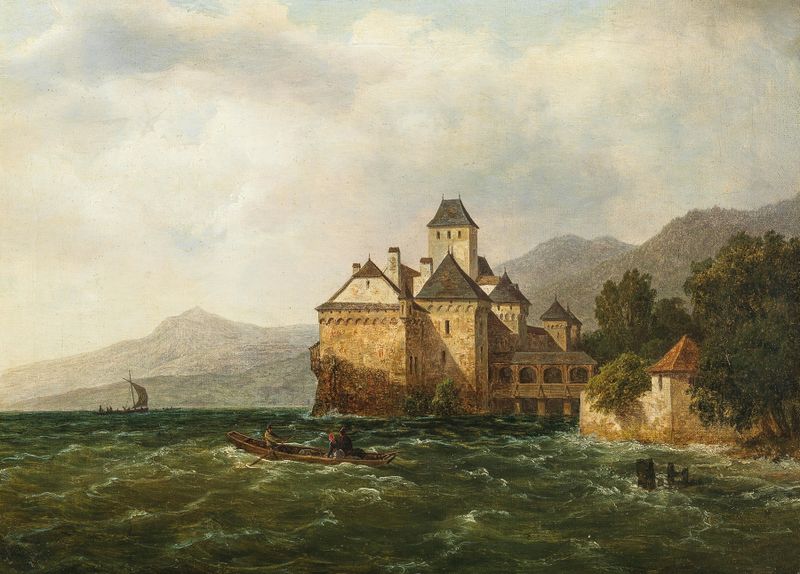
When did color learn to lie? In a world painted with hues both vivid and delicate, the fragility of beauty conceals deeper truths beneath its surface. Look to the center of the canvas, where an ethereal castle emerges from a veil of mist, its turrets softened by the embrace of twilight. The artist’s deft brushstrokes create an interplay of shimmering greens and muted blues, infusing the landscape with an otherworldly glow. Notice how the light catches the edges of the clouds, allowing the castle to appear as if it’s both a part of the earth and a specter of dreams, evoking a sense of both wonder and vulnerability in its isolation. As your gaze wanders, you might observe the juxtaposition between the grandeur of the castle and the surrounding nature, which seems to encroach upon it with subtle insistence.
The trees, though lush and vibrant, hint at an inevitable entrapment, mirroring the delicacy of existence itself. This contrast speaks to the transient nature of beauty, where the delicate balance between reality and imagination is ever precarious, inviting reflection on the impermanence of our own constructs. Piepenhagen created this work during a period marked by the Romantic movement's fascination with nature and the sublime. Though the exact date remains unknown, his landscapes reflect a time when artists sought to capture emotional states through scenery.
This was a turning point, as the art world began to embrace personal expression over strict realism, allowing the fragility depicted in Das Bergschloss to resonate with the era’s quest for meaning amidst the chaos of change.
More Artworks by August Piepenhagen
Browse all →
Returning Home Before the Storm in a Mountain Landscape
August Piepenhagen

Alte Dorfbrücke
August Piepenhagen

Nahendes Unwetter in den Bergen
August Piepenhagen

Wintry landscape
August Piepenhagen

Romantische Mondlandschaft mit Wanderer
August Piepenhagen

Gebirgslandschaft Mit Wanderer
August Piepenhagen
A View of Chillon Castle on Lake Geneva
August Piepenhagen

Die Aussichtswarte
August Piepenhagen
Schloss Chillon
August Piepenhagen

Wanderer vor weiter Landschaft
August Piepenhagen





