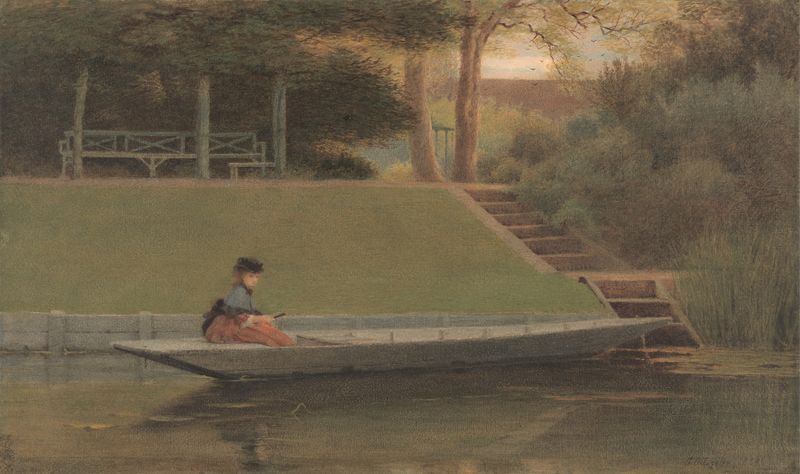
Day of Rest, Wallingford — History & Facts
In that stillness, memory lingers, beckoning us to explore the quiet depths of a moment captured on a sunlit afternoon. Look to the left at the young girl seated on the grass, absorbed in a book. Her delicate posture and serene expression draw the eye, framed by dappled light filtering through the trees. Notice how the warm hues of the sun illuminate her surroundings, blending soft greens with touches of gold.
The composition invites you into this tranquil oasis, where nature and human life coexist harmoniously. As your gaze wanders, subtle contrasts emerge. The girl's peaceful solitude juxtaposes the vibrant play of children in the background, embodying the fleeting joy of youth. The slightly blurred figures suggest movement, while the solid, focused presence of the girl evokes a sense of introspection.
This delicate balance between action and stillness speaks to the transient nature of these cherished summer days, urging viewers to reflect on their own memories of respite and leisure. In 1897, when this work was created, the artist was deeply immersed in the artistic landscape of late Victorian England. George Dunlop Leslie found himself in a world where the Pre-Raphaelite ideals were being challenged by new movements. He sought to portray the simplicity of everyday life, drawing from personal memories and pastoral themes, as the world around him evolved into modernity.