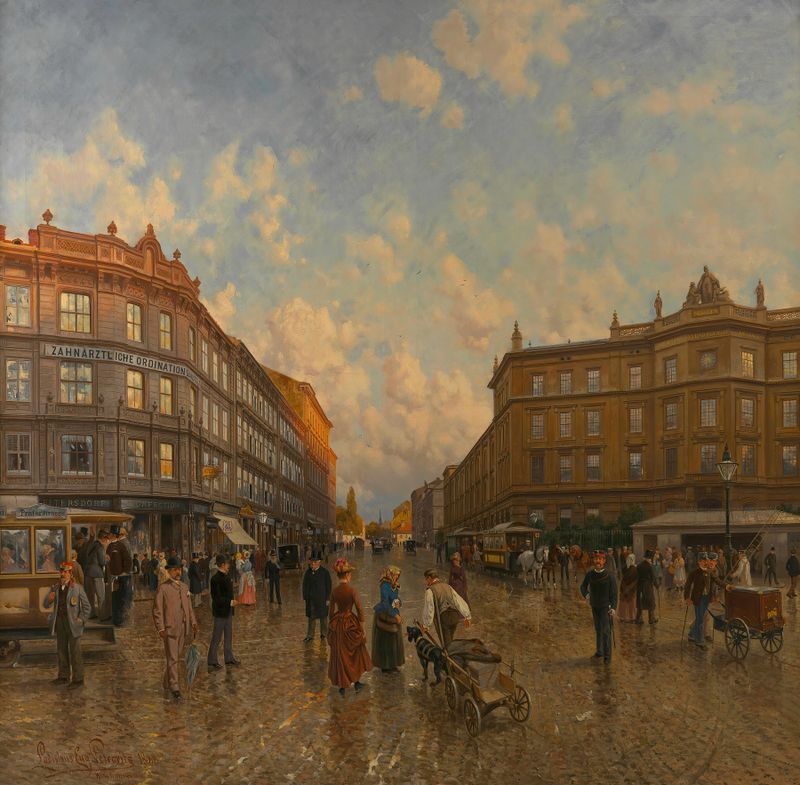
Der Graben im Jahr 1888 in Richtung Stock im Eisen — History & Facts
In the stillness of a forgotten moment, the weight of history presses against the canvas, whispering of legacies forged in solitude. Look to the right at the cascading hues of green and ochre, where the fading light dances over the tranquil surface of the water. Notice how the lines of the trees arch protectively, their branches merging with the sky, creating a harmonious frame. The artist employs a delicate palette, invoking a sense of nostalgia, while the brushwork is both meticulous and fluid, guiding the eye across the landscape like a gentle breeze. Yet, beneath the serene facade lies a dichotomy of existence.
The interplay of light and shadow not only enhances the depth of the scene but also evokes feelings of transition and impermanence. The hidden reflections on the water hint at memories—fleeting and elusive—reminding us of the passage of time and the stories left untold. In this stillness, the painting grapples with the tension between the visible world and the emotions that linger beneath the surface. In 1888, while creating this piece, Petrovits was immersed in the burgeoning world of Hungarian art, blending realism with his own introspective style.
He worked in Vienna and faced the challenges posed by a rapidly modernizing society, which often overshadowed traditional landscapes. This painting, then, becomes a testament to his dedication to capturing the essence of a moment, a legacy that resonates with both beauty and reflection.