
Die St. Martinskirche in Braunschweig — History & Facts
In the delicate brushstrokes of this artwork, the past whispers through the architecture, urging us to pause and reflect. Look closely at the imposing structure, where the St. Martin's Church rises majestically against a gentle sky. Notice how the artist captures the play of light on the stone façade, emphasizing its intricate details.
The steeple reaches tall, a silent guardian standing against the passage of time, while the surrounding trees, painted in soft greens, cradle the church, creating a sense of harmony amid the weight of history. Delve deeper into the composition, and you’ll find contradictions in the portrayal of the church. The solidity of the stone contrasts with the ephemeral quality of the clouds above, suggesting the tension between permanence and transience. Small figures scattered in the foreground add life, yet their subtle presence reminds us of the fleeting nature of humanity under the gaze of enduring faith and tradition.
Each element interweaves to evoke a profound contemplation of time's passage. In 1862, Neher painted this piece during a period when Romanticism was giving way to Realism in Germany. He focused on the authenticity of place and historical context, capturing both the architectural beauty and the cultural significance of the church in Braunschweig. This era was marked by a growing interest in local history and identity, prompting artists to reflect their surroundings with an intense and personal lens.
More Artworks by Michael Neher
Browse all →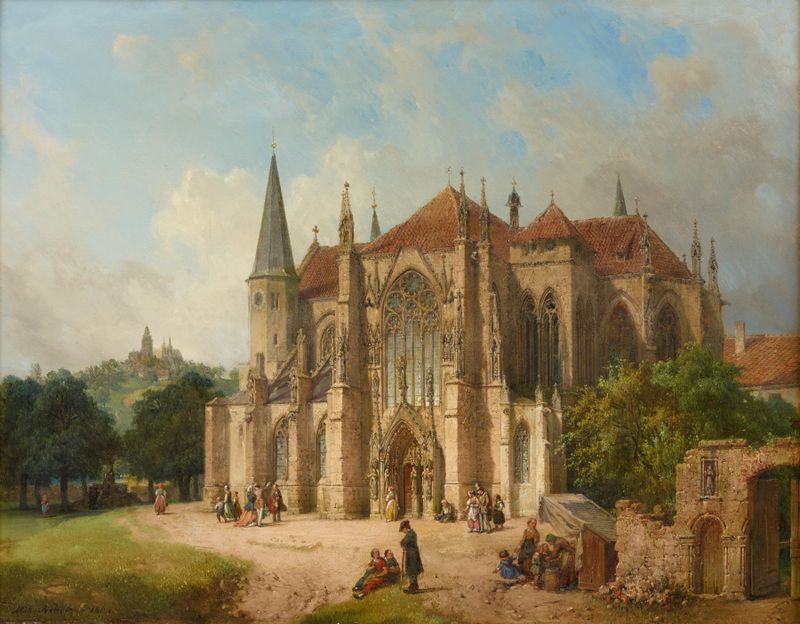
More Architecture Art
Browse all →
The statue of Liberty
Frédéric Auguste Bartholdi

View of Houses in Delft, Known as ‘The Little Street’
Johannes Vermeer

View of Houses in Delft, Known as ‘The Little Street’
Johannes Vermeer

The Cathedral in Rouen. The portal, Grey Weather
Claude Monet

The yellow house
Vincent van Gogh

The Church in Auvers-sur-Oise, View from the Chevet
Vincent van Gogh