
The Basilica of Constantine, Rome — History & Facts
Did the painter know this moment would outlive them? As sunlight cascades through the majestic arches, illuminating the enduring beauty of a once-glorious structure, one can’t help but ponder the divinity captured in this fleeting instant. Focus on the grand façade of the Basilica, where the intricate details of the stonework draw the eye—every curve and angle meticulously rendered. The artist’s choice of earthy tones contrasts elegantly with the ethereal quality of the light streaming in, creating a harmony that feels both ancient and alive. Notice how the shadows dance along the walls, revealing the texture of time etched into each surface, inviting the viewer to explore further into the depth of the scene. Hidden within this depiction lies a conversation between decay and beauty, a reminder of the passage of epochs.
The remnants of the basilica speak not only of architectural prowess but also of human ambition, echoing the prayers offered within its walls. In this interplay of light and shadow, the artist reveals a poignant juxtaposition—the glory of the past still resonates, even as nature reclaims what was built with such fervor. In 1830, Michael Neher painted this scene amidst a Europe grappling with the aftermath of revolution and new ideas around art and architecture. The Romantic movement flourished during this period, offering a renewed appreciation for the sublime, a sense of longing for the past, and a deep exploration of human emotion.
Neher, entrenched in this evolving context, sought to immortalize not just a building, but the spirit of an era captured in stone.
More Artworks by Michael Neher
Browse all →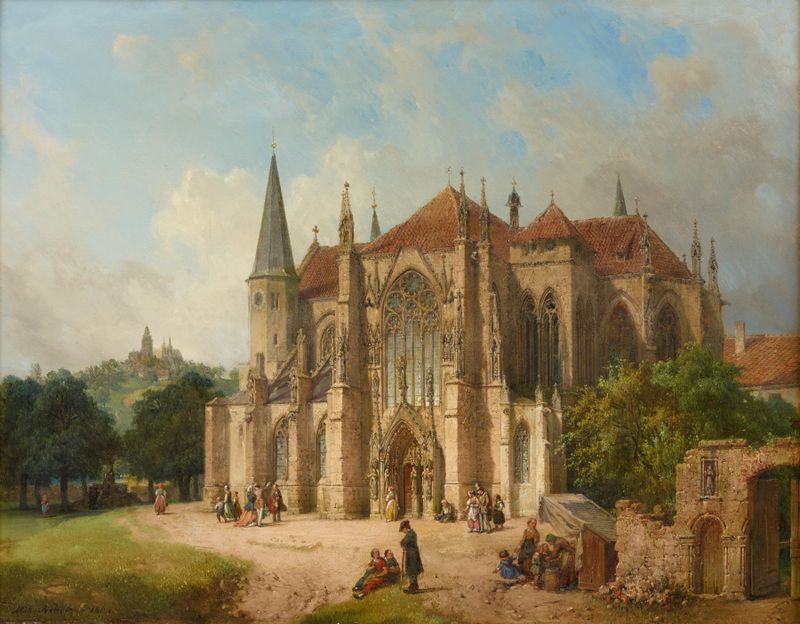

More Architecture Art
Browse all →
The statue of Liberty
Frédéric Auguste Bartholdi

View of Houses in Delft, Known as ‘The Little Street’
Johannes Vermeer

View of Houses in Delft, Known as ‘The Little Street’
Johannes Vermeer

The Cathedral in Rouen. The portal, Grey Weather
Claude Monet

The yellow house
Vincent van Gogh

The Church in Auvers-sur-Oise, View from the Chevet
Vincent van Gogh