Eastern Harbour — History & Facts
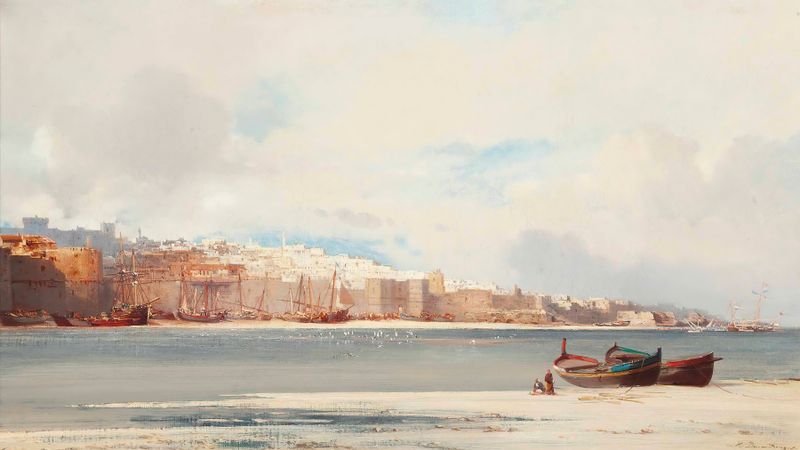
What secret hides in the quiet of the canvas? In the stillness of Eastern Harbour, a world emerges, layered with whispers of legacy and tranquility. Look to the right at the gentle caress of light as it dances across the water’s surface, shimmering with shades of blue and green. The boats, anchored like thoughts left to drift, are rendered with delicate strokes that evoke a sense of repose. Notice how the horizon blends into soft, muted colors of dusk, creating a serene atmosphere while hinting at the passage of time.
Every brushstroke is deliberate, revealing the artist's mastery in capturing both detail and mood. Delving deeper, a contrast arises between the stillness of the water and the potential for movement suggested by the boats. Perhaps they symbolize memory, resting in their harbor of nostalgia, while the distant landscape invites the viewer to consider the journeys not taken. The ethereal quality of the light speaks to the fragility of existence, urging us to reflect on the legacies left behind, quietly beckoning us to remember the stories yet to unfold. In 1871, Jean-Baptiste-Henri Durand-Brager painted this piece during a time of profound change in the world of art, as Impressionism began to emerge.
Living in Paris, he was influenced by the evolving techniques of his contemporaries, experimenting with light and atmosphere while melding traditional techniques with a new vision. This work embodies his dedication to the maritime scenes he cherished, capturing the essence of a harbor not just as a location, but as a meeting point of memories and aspirations.