End of Day (‘The Dying Years’) — History & Facts
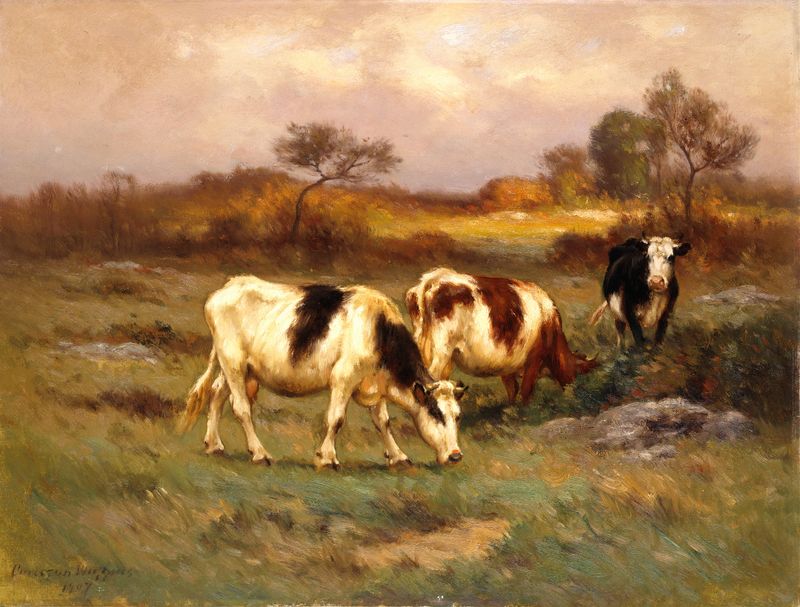
What if beauty was never meant to be finished? In End of Day (‘The Dying Years’), Carleton Wiggins captures the poignant essence of fleeting moments, draped in the soft hues of twilight, where loss lingers like a whisper in the air. Look to the left at the delicate interplay of colors in the sky, where amber and violet brush against each other, illuminating the serene horizon. The horizon itself appears to cradle the fading light, while the silhouettes of trees stand as silent witnesses, their dark forms contrasting against the vibrant backdrop. Notice how the cool shadows meld with the warm glow, evoking a sense of both calm and melancholy, drawing the viewer into the deepest recesses of reflection. The juxtaposition of light and shadow embodies the duality of life and death; the sun's descent hints at the inevitable conclusion of day, mirroring the passage of time and the weight of nostalgia.
Each brushstroke serves as a testament to the beauty that lies in transience, suggesting that loss is not merely an end, but also a profound appreciation for what once was. The stillness of the landscape invites contemplation, leaving viewers to grapple with their own interpretations of beauty and its impermanence. In 1890, Wiggins painted End of Day during a period marked by an increasing appreciation for naturalism and impressionistic techniques. Working primarily in the United States after studying in Europe, he focused on rural landscapes, reflecting the late 19th-century artistic shift toward emphasizing nature's emotional resonance.
This painting, like much of his work, serves as a mirror to a world grappling with change, as industrialization began to overshadow the pastoral serenity he so lovingly depicted.