Evening after a Shower — History & Facts
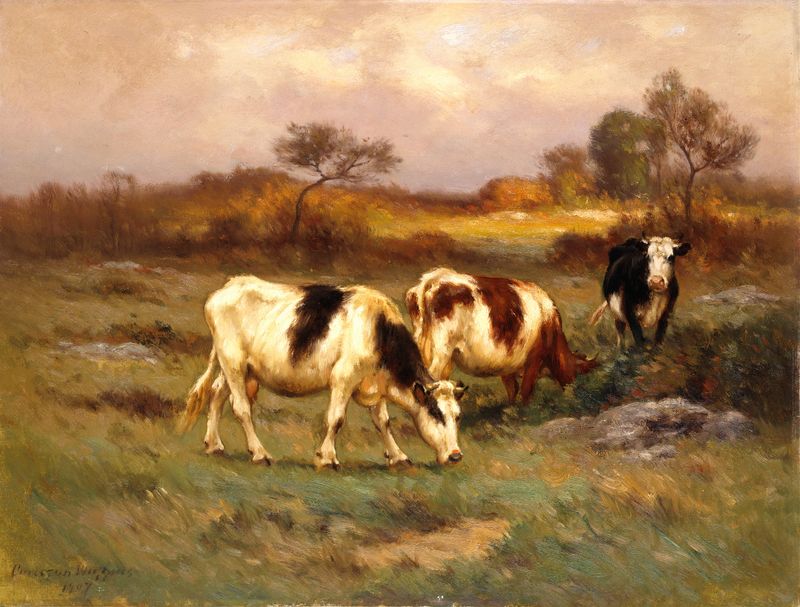
In the world of art, transformation often resides in the delicate balance of emotion and revolution, revealing nature’s unrefined beauty and the artist's spirited endeavor to capture it. Look closely at the interplay of light and shadow in the foreground. The lush greens of the grass glisten with remnants of a recent shower, while the sky overhead boasts an intricate web of soft blues and silvery grays. The brushstrokes are vigorous yet poised, as if they dance across the canvas to evoke the atmospheric tension of an evening just past the rain.
The horizon, where the earth meets the heavens, draws the eye and invites the viewer to contemplate the serene beauty of the moment. Observe the subtle details that underpin this scene: droplets of water clinging to blades of grass, the gentle swell of a distant field bathed in a soft glow. The contrast between the vibrant life in the foreground and the hazy expanse of the background mirrors a fleeting moment—one that carries both the weight of the past and the promise of renewal. This duality invites a reflection on nature's capability to evolve, to embrace change, and to find tranquility amidst chaos. In 1907, while creating this piece, the artist found himself amidst an artistic community that was increasingly influencing the American landscape with a fresh perspective.
Wiggins, who had spent years experimenting with impressionistic techniques, was attuned to nature’s nuances and the dynamics of light. This painting emerged as a testament to his evolving vision, capturing a moment where serenity and revolution intertwined in the heart of the American landscape.