
Esquisse pour l'escalier des fêtes de l'Hôtel de Ville de Paris , Un coin du vieux Passy — History & Facts
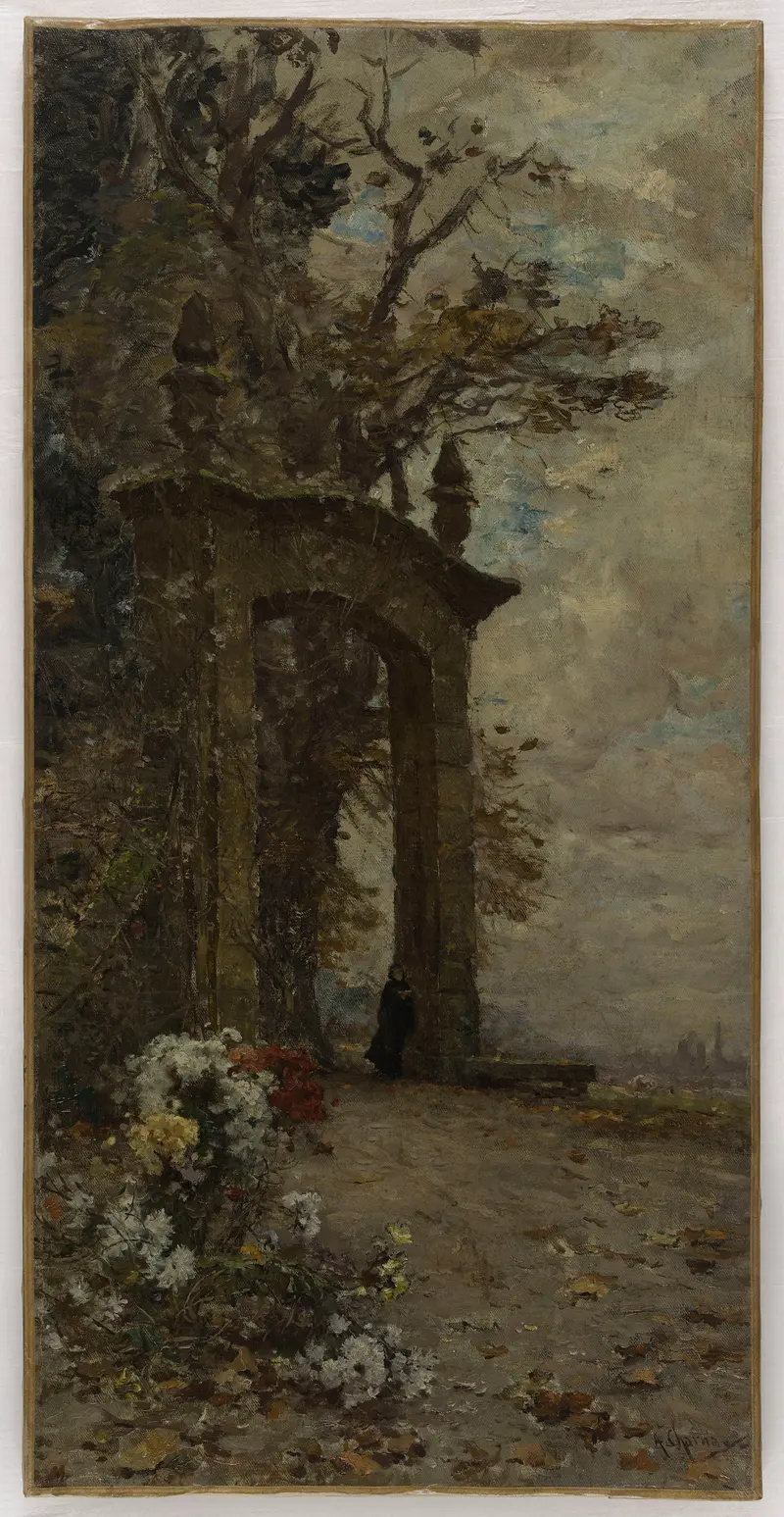
A single figure in black, dwarfed by a grand, weathered stone arch, draws the viewer into a world where memory and solitude linger in every brushstroke. The arch, with its classical finials, stands as a silent witness to the passage of time, half-consumed by the wild tangle of autumn trees. At the painting’s foot, a burst of white and red flowers—perhaps left as a tribute—contrasts with the muted earth tones, suggesting a moment of remembrance or quiet mourning.
The sky, heavy and uncertain, presses down on the scene, its pale blues and greys dissolving into the bare branches above. The eye is led from the flowers, across the scattered leaves, and up through the archway, where the lone figure seems to merge with the shadows, inviting questions about their story and purpose. Painted in 1892 by Armand Charnay, this work belongs to a period when artists across France were turning their gaze to the vanishing corners of old neighborhoods and the poetry of neglected spaces. The title, referencing Passy—a district in Paris once known for its village charm—hints at a nostalgia for a city rapidly modernizing.
Such scenes were often commissioned or collected by those seeking to preserve the memory of a disappearing world, and the painting’s presence today in the Paris Musées collection places it among the city’s visual archives. Little is recorded about this specific work’s journey, but its mood and palette speak volumes about the late 19th-century fascination with ruins, memory, and the quiet drama of everyday life. The longer you look, the more the silence of the scene seems to echo with unspoken histories.
More Artworks by Armand Charnay
More Landscape Art

The Starry Night
Vincent van Gogh

View of Delft
Johannes Vermeer

Water Lilies
Claude Monet

The Grand Canal, Venice, looking north-west from the Ca' Corner to the Ca' Contarini degli Scrigni, with the campanile of Santa Maria della Carità
Canaletto

Windsor Castle
Canaletto

The Grand Canal looking North-East from the Palazzo Dolfin-Manin to the Rialto Bridge
Canaletto