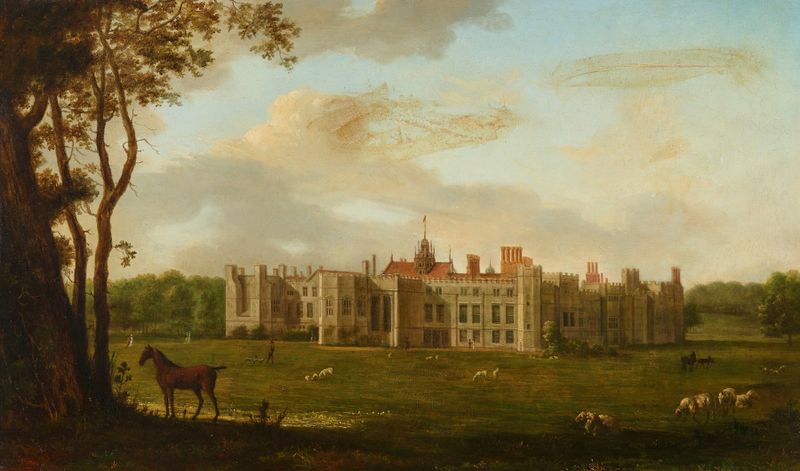
Fauldon,South Greenhoe,Norfolk — History & Facts
In the stillness of memory, loss hangs heavy—an unspoken weight that echoes through the canvas. Each brushstroke seems to whisper secrets of a bygone era, inviting viewers into a poignant space filled with absence and reflection. Look to the foreground where gentle, undulating hills embrace a modest settlement, their warm greens and browns inviting the eye into a serene landscape. Notice how the light plays across the scene, illuminating rooftops with a soft glow that hints at a fading world.
The artist’s meticulous technique captures the essence of rural life, while a muted palette enhances the feeling of nostalgia, evoking a sense of yearning for what once was. In the distance, solitary figures traverse the fields, their gestures imbued with an almost ghostly quality, suggesting that they are remnants of a past long gone. The winding paths lead away into the horizon, symbolizing the journey of life and the inevitable distance created by time. The interplay of shadow and light reflects emotional contrasts—hope entwined with sorrow, presence shadowed by absence. Hendrik Frans de Cort likely painted this piece in 1794, during a time when Europe was poised on the brink of significant change.
Living in England, he was influenced by the pastoral ideals of Romanticism and the burgeoning appreciation for rural landscapes. As he captured the quiet beauty of Norfolk, he also distilled the essence of a world facing the uncertainties of the modern age—one where the echoes of the past continue to resonate in the silent spaces of the present.