
Ferme En Normandie — History & Facts
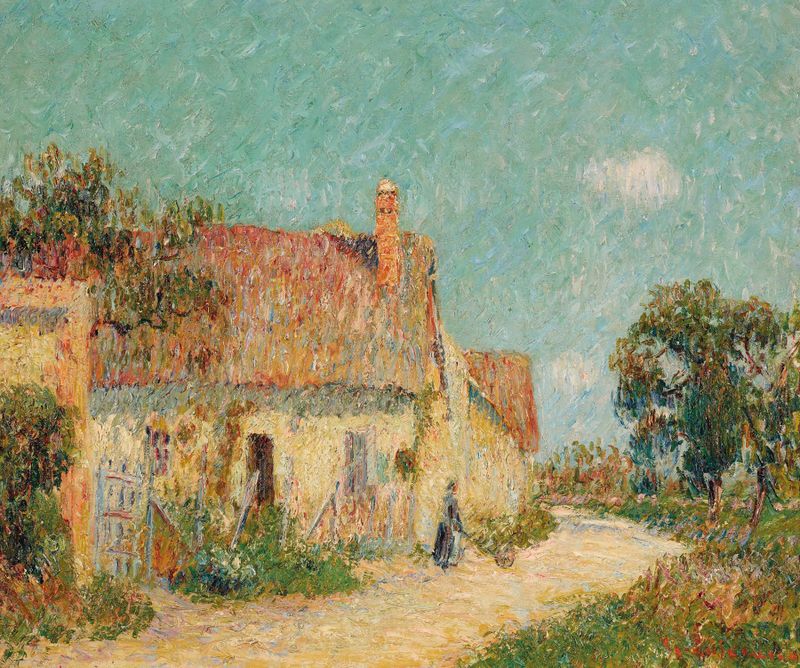
Is this a mirror — or a memory? The landscape unfolds like a whispered confession, inviting the viewer to step into a moment suspended between reality and longing. Look to the left at the gently rolling hills, softened by a palette of greens and golds. The dappled light dances across the fields, highlighting the textured strokes that evoke the breath of the earth. Notice how the sky above, a delicate wash of cerulean, contrasts with the rich, dark tones of the farmhouse, suggesting both warmth and isolation.
The composition lures you in, placing the structure at the center, yet its shadowed presence hints at secrets unspoken. Deeper insights reveal an interplay of serenity and unease. The lushness of the fields teeters on the edge of abandonment, while the farmhouse stands as a silent witness, perhaps harboring tales of betrayal and loss. Each brushstroke articulates a tension between beauty and decay, where the idyllic scene masks an undercurrent of unresolved sentiments.
The juxtaposition of vibrant life against a potential void reflects the artist's exploration of both nature and human emotion. In 1926, Loiseau painted this work during a time marked by personal transition and social upheaval in France. The post-World War I landscape saw artists grappling with their identities and the changing world around them. Loiseau emerged from the Impressionist tradition, yet sought to capture the essence of his surroundings in a more intimate, contemplative manner, infusing the landscape with poignant emotional depth.
More Artworks by Gustave Loiseau
Browse all →
Rue de village en Normandie
Gustave Loiseau
Chaumière en Normandie
Gustave Loiseau

Paysage d’Hiver à Chaponval
Gustave Loiseau
Tournant de rivière, L’Eure
Gustave Loiseau

Pont Marie, Paris
Gustave Loiseau

Le Bras De Mer
Gustave Loiseau

Le Pont Suspendu À Triel
Gustave Loiseau

Bord de la rivière
Gustave Loiseau
Le Quai Duquesne à Dieppe
Gustave Loiseau

Rocher la Teignouse, Cap Fréhel
Gustave Loiseau





