Fifth Avenue in Winter — History & Facts
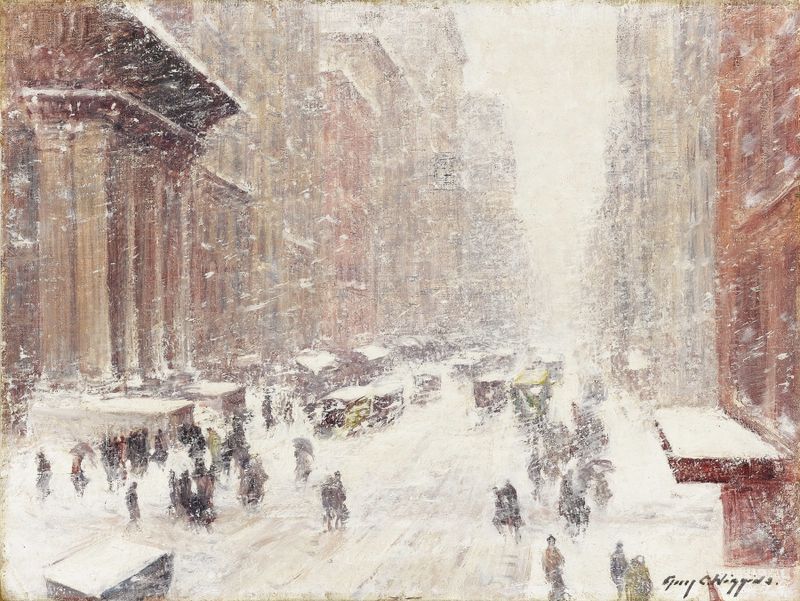
Who listens when art speaks of silence? In the hush of a winter’s day, the stillness of Fifth Avenue in Winter invites contemplation, a quiet fear lurking beneath its icy surface. Look to the right at the figures bundled in heavy coats, their muted colors blending with the palette of grays and whites that dominate the scene. The artist’s brushwork captures the delicate flurries of snow drifting through the air, while the stark architecture of Fifth Avenue looms in the background. Notice how the light reflects off the wintry ground, creating a glistening path that draws the eye toward the distant horizon, hinting at both beauty and an unsettling chill. The contrast between warmth and cold runs deep in this work.
The individuals huddled against the elements embody resilience, yet their isolation evokes an undercurrent of anxiety, a fear of the unseen that winter so often brings. The emptiness of the streets amplifies this sentiment, suggesting a world paused in the grip of the season, where life is both dulled and heightened in its stillness. In the early 1910s, Wiggins was established in New York City, where the art world was shifting toward modernism, yet he drew inspiration from the more traditional landscapes and urban scenes. During this period, the city experienced a burgeoning vitality, yet it was also marked by social challenges and a growing sense of alienation.
Fifth Avenue in Winter reflects not just the serenity of a snowy scene, but also the complexities of life in a rapidly changing world.