Fishing boats in a stiff breeze offshore — History & Facts
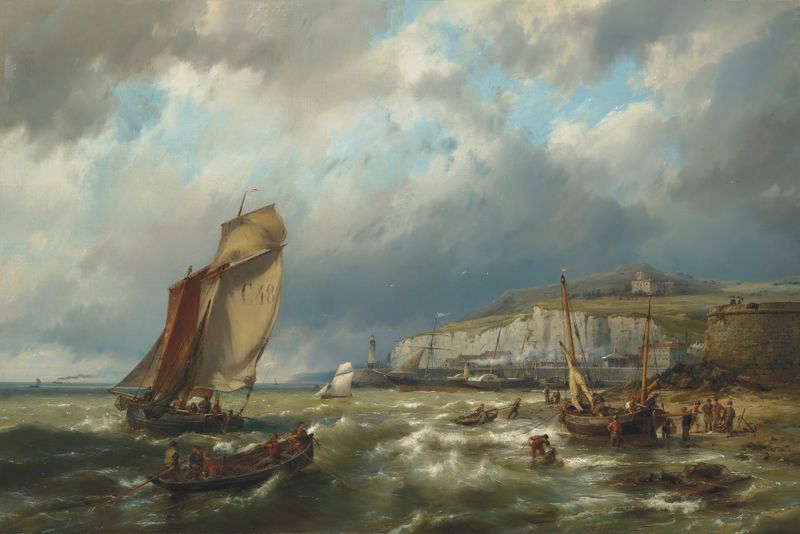
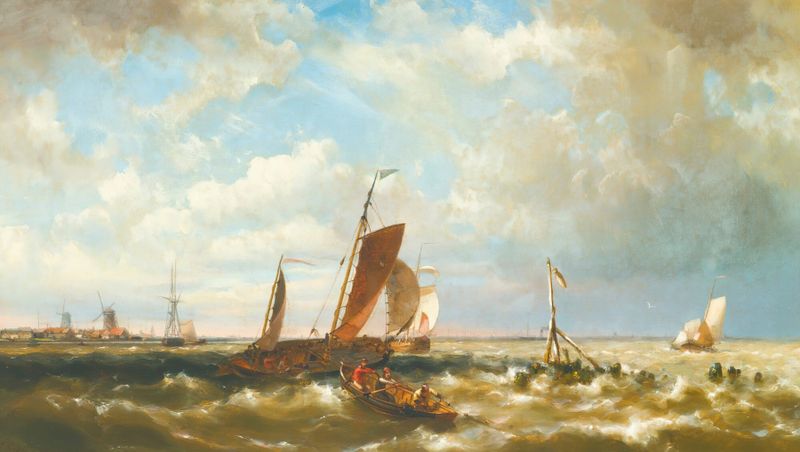
Can beauty exist without sorrow? In the tumultuous dance of waves and wind, the duality of nature unfolds, revealing a delicate balance between chaos and grace. Look to the left at the bold strokes that define the fishing boats, their hulls curving elegantly against the backdrop of churning waters. The artist employs a palette of deep blues and frosty whites, capturing the restless spirit of the sea on a blustery day. Notice how the light catches the sails, almost translucent, fluttering as they strive against the gusts, while the foaming crests of the waves emphasize the tension between the boats' stability and the stormy environment surrounding them.
Each brushstroke conveys movement, inviting the viewer to sense the brisk wind and feel the salty spray. There lies an inherent contrast within the composition—a struggle between human endeavors and nature's formidable power. The fishermen, depicted as silhouettes on the horizon, embody resilience against the elements, yet their distant presence also infers isolation. The interplay of light and dark hints at the uncertainty of their journey, revealing a story of survival and vulnerability amidst the beauty of their surroundings.
This balance of hope and peril anchors the narrative within the painting, as it encourages contemplation of the human experience against the vastness of nature. In 1859, Hermanus Koekkoek the Younger painted this work in his studio in the Netherlands, amidst a rising interest in maritime scenes influenced by the Romantic movement. During this period, the artist sought to capture the sublime power of nature, often intertwining it with themes of adventure and life’s uncertainties. His work reflects not only his technical prowess but also the zeitgeist of an era that revered the sea as both a provider and a formidable adversary.