Fishing Village in Bohuslän — History & Facts
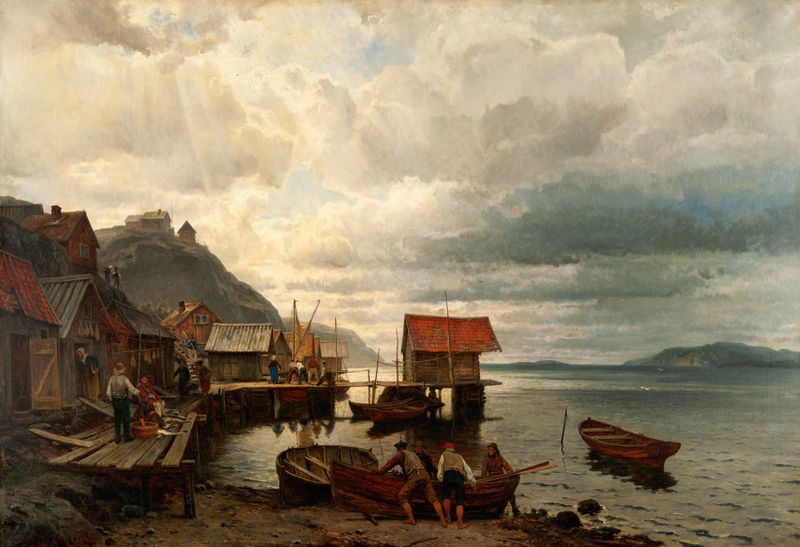
What if beauty was never meant to be finished? In Johan Edvard Bergh's Fishing Village in Bohuslän, we find an encapsulation of a moment that feels both serene and poignant, as if time itself has paused to reflect on the fragility of life and labor. Look to the left at the sturdy wooden boats, their vibrant colors contrasting against the muted hues of the weathered shacks. Observe how the fluid brushstrokes of the water seem to ripple with an underlying current, hinting at the work and lives intertwined with the sea. The pale sun filters through a veil of clouds, casting gentle light that dances across the scene, highlighting the rugged beauty of the landscape while maintaining an aura of melancholy. Beneath the surface tranquility lies a narrative of betrayal—the harsh realities of dependence on the sea loom large.
The fishing village, with its quaint appearances, masks the uncertainty faced by those who dwell there. The interplay of light and shadow subtly evokes the duality of hope and despair, symbolizing both the promise of the catch and the peril of loss. Each element, from the distant hills to the boats bobbing in the harbor, speaks of transience, leaving viewers to ponder what lies beyond appearances. In 1867, Bergh created this poignant piece while living in Sweden, a time when the country was grappling with its identity amidst social and industrial changes.
The rise of urbanization began to alter traditional ways of life, bringing both opportunity and upheaval. Engaging with the natural beauty of his homeland, Bergh's work reflects not only the idyllic façade of rural communities but also their deeper struggles, a juxtaposition that resonates with contemporary audiences.