
Fjordlandschaft — History & Facts
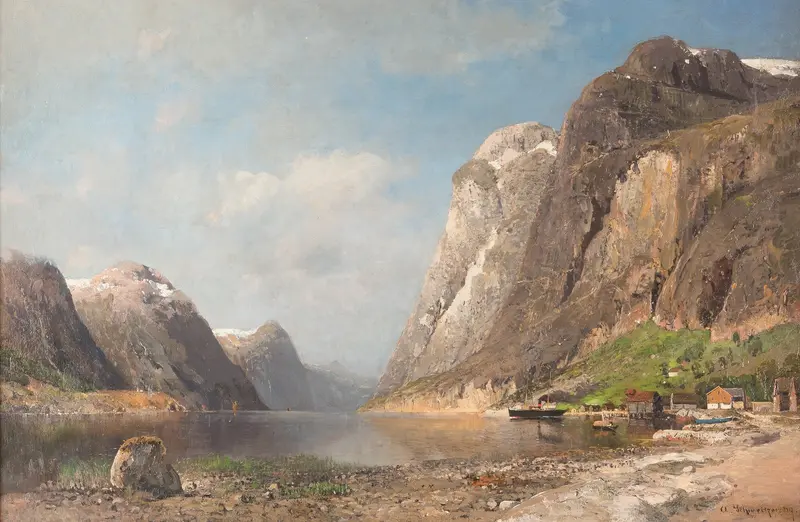
A hush settles over the water, broken only by the faint movement of oars and the distant plume of smoke from a steamer—Fjordlandschaft draws the eye first to the sheer, monumental cliffs that rise almost vertically from the glassy surface. The drama of the scene is not in storm or shipwreck, but in the quiet tension between human presence and geological grandeur. The painter leads us from the pebbled shore, where a cluster of boats and figures suggest daily life, across the reflective water that doubles the cliffs’ height, and into the deep corridor of stone and cloud.
The light, breaking through heavy clouds, picks out the green slopes and the whitewashed buildings, hinting at a moment of calm after rain. Every detail, from the careful rigging of the boats to the patchwork of moss on rock, is a deliberate invitation to linger. Painted in 1888, this work belongs to a period when the northern landscape was a favored subject for artists seeking to capture both the wildness and the inhabited edges of Europe. In the late nineteenth century, scenes like this were collected by a growing middle class eager to display both taste and a sense of distant adventure—often as reminders of travels or aspirations.
The genre flourished as advances in travel brought remote places within reach, and painters responded with ever more precise renderings of light and topography. Though little is recorded of Adolf Gustav Schweitzer’s wider reputation today, this painting—now in the Dorotheum collection—stands as a testament to the era’s fascination with nature’s scale and the quiet persistence of human life within it. Notice how the painting rewards a slow gaze: the longer you look, the more the landscape seems to reveal.
More Artworks by Adolf Gustav Schweitzer
More Landscape Art

The Starry Night
Vincent van Gogh

View of Delft
Johannes Vermeer

Water Lilies
Claude Monet

The Grand Canal, Venice, looking north-west from the Ca' Corner to the Ca' Contarini degli Scrigni, with the campanile of Santa Maria della Carità
Canaletto

Windsor Castle
Canaletto

The Grand Canal looking North-East from the Palazzo Dolfin-Manin to the Rialto Bridge
Canaletto