
Herbstmorgen G 4944 Lenbachhaus — History & Facts
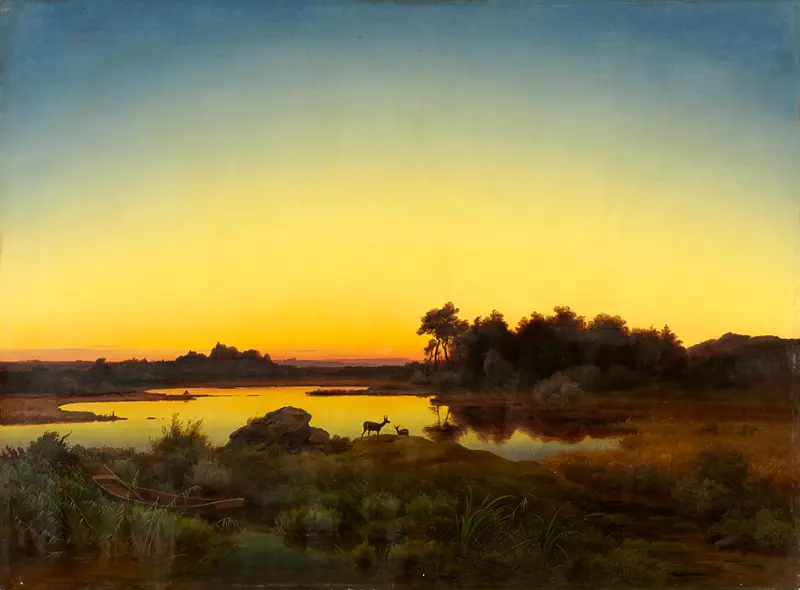
What first holds the eye in Herbstmorgen G 4944 Lenbachhaus is not a dramatic event, but the hush that hangs over the scene, as if the land itself is holding its breath. The painter, Anton Zwengauer, gives the sky the largest share of the canvas, a pale expanse that presses gently down on the shadowed trees and the still pond below. The light is soft, almost diffused, and the misty air blurs the edges of the distant woods, drawing the viewer into a world balanced between waking and dreaming.
At the water’s edge, a pair of ducks glide quietly, their presence a subtle reminder that life continues even in the quietest hours. The fallen tree, half-sunken and overgrown, hints at the slow passage of time, nature’s patient reclaiming of its own. Painted in 1841, this work belongs to a moment when German landscape painting was shifting from the heroic vistas of earlier decades to more intimate, contemplative studies of nature. Artists like Zwengauer found inspiration in the everyday countryside, capturing the moods of dawn and dusk, the play of fog and light.
Such paintings were often collected by a rising middle class, eager to bring the calm and order of rural scenes into their city homes. Today, Herbstmorgen G 4944 Lenbachhaus is housed in the Lenbachhaus collection, a quiet testament to a time when the landscape itself was seen as a source of reflection and solace. The longer you look, the more the scene seems to open, inviting you to linger in its gentle, watchful silence.
More Artworks by ANTON ZWENGAUER
More Landscape Art

The Starry Night
Vincent van Gogh

View of Delft
Johannes Vermeer

Water Lilies
Claude Monet

The Grand Canal, Venice, looking north-west from the Ca' Corner to the Ca' Contarini degli Scrigni, with the campanile of Santa Maria della Carità
Canaletto

Windsor Castle
Canaletto

The Grand Canal looking North-East from the Palazzo Dolfin-Manin to the Rialto Bridge
Canaletto