Hirte in bergiger Landschaft — History & Facts
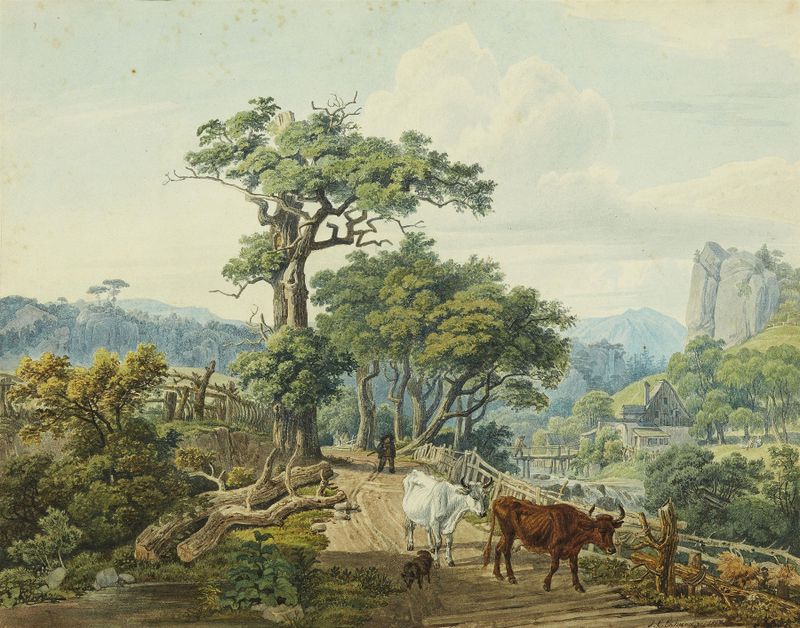
Can paint confess what words never could? In the stillness of Hirte in bergiger Landschaft, the passage of time whispers through each brushstroke, inviting us to ponder the fleeting moments held within its frame. Focus on the figure of the shepherd, slightly to the left, as he stands against the rugged backdrop of jagged mountains. Note how the earthy greens and browns of the landscape cradle him, while soft, golden hues illuminate the peaks in the distance, evoking a sense of warmth amid the coolness of the terrain. The gentle curves of the hills contrast with the starkness of the rocks, creating a harmonious balance that reflects both the beauty and harshness of nature. The painting captures an emotional tension between solitude and connection.
The shepherd, though physically isolated in the expansive landscape, represents humanity's eternal bond with nature and time. His posture, relaxed yet vigilant, speaks to the patience required in both shepherding and life itself. The undulating hills echo the rhythm of the seasons, suggesting a cyclical nature of existence, while the distant mountains symbolize aspirations and dreams that remain perpetually out of reach. Created in 1817, Hirte in bergiger Landschaft was painted during a period when Johann Christoph Erhard was establishing his reputation as a landscape artist in Germany.
This era was marked by a growing appreciation for the sublime beauty found in nature, reflecting Romantic ideals. Erhard’s work emerged from a time of personal and artistic exploration, as he sought to capture the essence of the natural world and the emotions it evokes.