In the Catskills — History & Facts
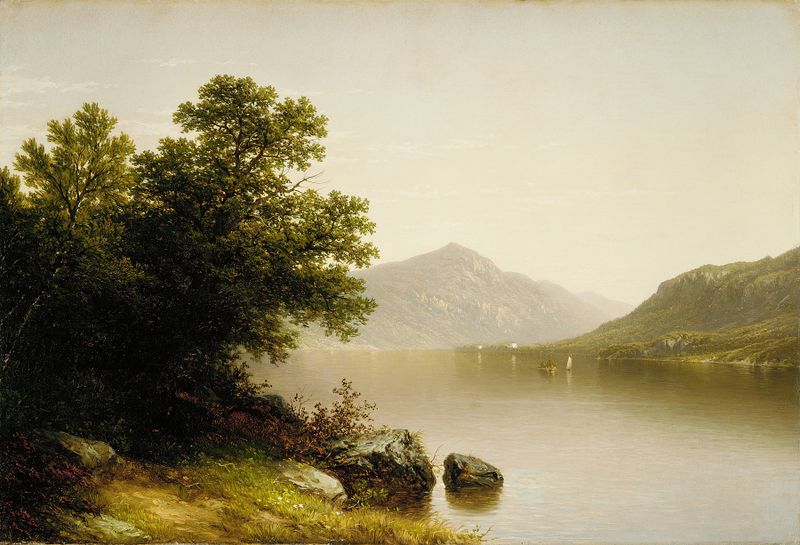
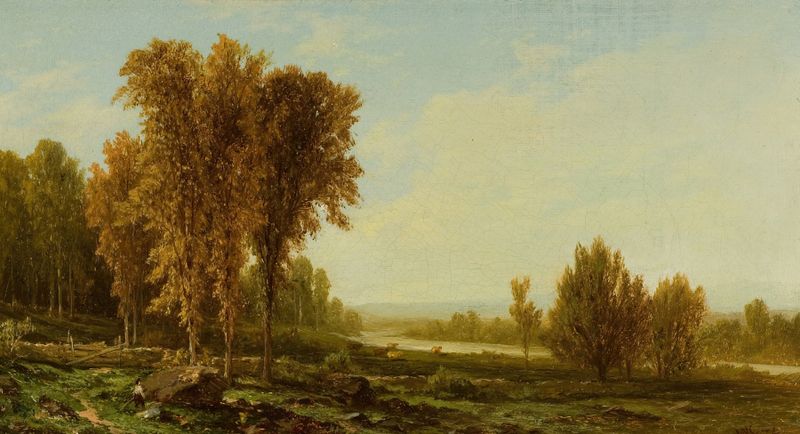
Can beauty exist without sorrow? This question lingers like the soft mist that envelops the rolling hills in the distance, inviting contemplation in every brushstroke. Look to the left at the vibrant greens of the foliage, a testament to the artist’s mastery of natural hues. Notice how the light filters through the leaves, creating a dance of shadows and illumination that guides your gaze across the landscape. The gentle ripples of the water reflect both the vibrant sky and the solemnity beneath, offering a duality that speaks to life’s complexities.
Each element in this serene composition, from the towering trees to the distant mountains, is placed with intention, crafting a harmonious yet layered tableau. The painting reveals subtle contrasts: the peace of nature juxtaposed with an underlying tension of solitude. The small cabin tucked away hints at human presence, yet it stands quietly, almost forgotten amidst the vast expanse of wilderness. The interplay of light and shadow evokes a sense of transience, suggesting that even within beauty, there lies an ephemeral quality—a reflection of fleeting moments, whispers of joy tinged with melancholy. Created during an era of great transformation in America, the artist focused on portraying the natural beauty of the Catskills.
In the mid-19th century, as artists began to embrace the American landscape, he sought to capture not just the beauty of nature but the deeper emotional resonance it held for viewers. This work stands as a testament to that time, where art became a means to explore the relationship between humanity and the vast, often daunting forces of the world around us.