Italian landscape with hunters — History & Facts
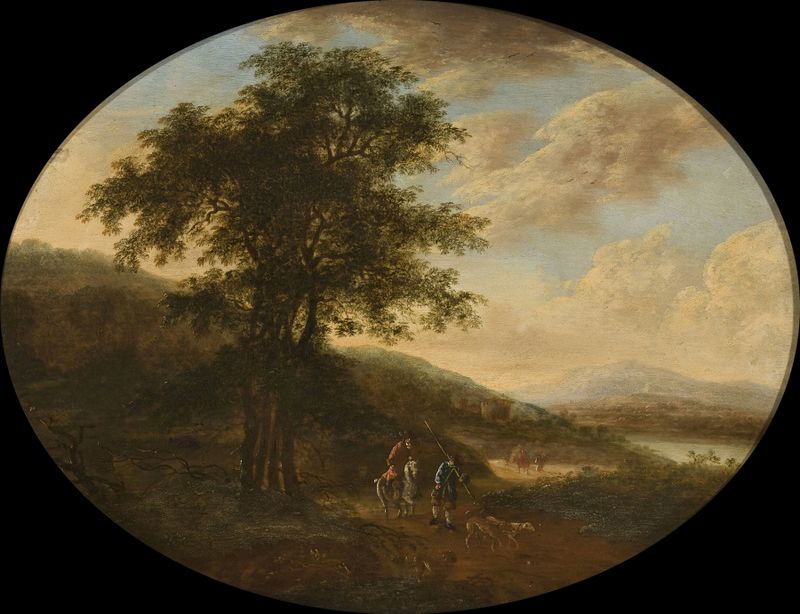
How does a fleeting moment within nature capture the heart of loss? In a world reshaped by time, we find ourselves reflecting on how memories linger in the hues of a landscape. Focus on the foreground where the vibrant greens and browns of the Italian landscape collide with the muted tones of distant hills. Notice the hunters in the mid-ground, their figures silhouetted against the sunset, casting long shadows that stretch toward the viewer. The delicate interplay of light and shadow creates a tension that hints at something unsaid—perhaps the hunt is not just for game, but for a sense of belonging or a return to lost innocence. Look closely at the intricate detailing in the foliage, where each brushstroke reveals both vibrancy and decay.
The hunters seem almost poised in a moment of anticipation, their gazes directed off-canvas, suggesting a profound yearning. This tension between the beauty of nature and the inherent violence of hunting speaks volumes about human experience—loss intertwined with the inexorable passage of time, mingling hope with despair. Ottomar Hackius painted this piece in 1661, during a period marked by the Baroque movement’s exploration of light and emotion. Living in Germany while drawing inspiration from Italian landscapes, he was at a crossroads of cultural exploration.
His work reflects not only personal experiences but also the broader movement in art, where landscapes became a medium for deeper introspection amidst a rapidly changing world.