Italienische Campagna mit Aquädukten links — History & Facts
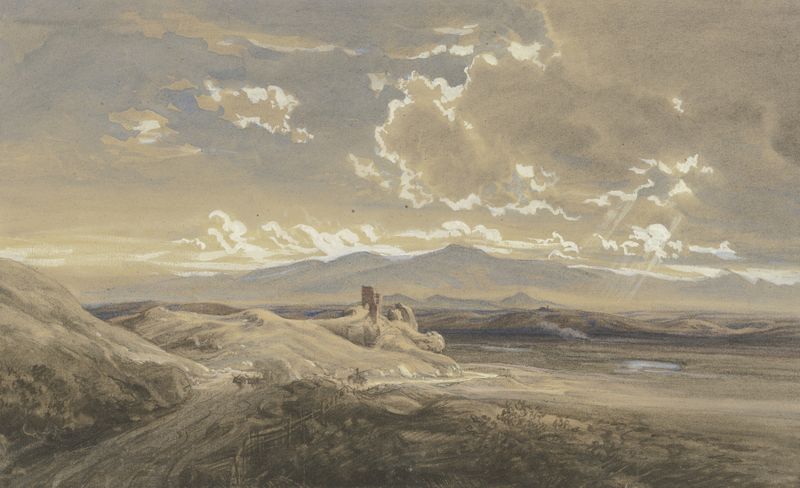
Can beauty exist without sorrow? In Italienische Campagna mit Aquädukten links, the viewer encounters a landscape that answers with a resounding complexity, where nature's splendor coexists with the weight of history. The canvas breathes life into the Italian countryside, showcasing its serene beauty while hinting at the stories etched within the land. Look to the horizon, where gentle hills roll beneath a vast sky painted in soft blues and warm ochres. Notice how the aqueducts rise majestically on the left, their stoic arches both a marvel of engineering and a symbol of past glories.
The artist's brushwork captures the delicate interplay of light, illuminating patches of vibrant greenery that contrast with the earthy tones of the structures. Each stroke invites the eye deeper into this tranquil yet poignant landscape. Within the scene lies a rich tapestry of emotions. The aqueducts, sturdy and proud, represent human achievement and the passage of time, yet their weathered surfaces suggest the inevitable decay that accompanies beauty.
The juxtaposition of man-made marvel and the untouched nature surrounding it evokes a timeless dialogue about civilization's fleeting nature. The soft clouds above, though beautiful, cast an ambiguous shadow that reflects the melancholy of what has been lost in the pursuit of progress. Eduard Wilhelm Pose painted this masterpiece in 1853, during a period of burgeoning Romanticism that celebrated the majesty of nature and human creativity. Living in Germany yet captivated by the landscapes of Italy, he found inspiration in the ruins and relics that spoke of both beauty and transience.
At that time, artists were increasingly drawn to subjects that conveyed emotional depth, and Pose's work is a testament to the interplay of beauty and the bittersweet essence of existence.