
Jerusalem from the Mount of Olives — History & Facts
Did the painter know this moment would outlive them? The quiet urgency of capturing a city teeming with history and turmoil resonates deeply, challenging us to confront the madness of time and memory. Focus on the expansive view of the cityscape before you. Look to the left at the gentle rise of olive trees, their muted greens contrasting with the warm, golden hues of Jerusalem’s ancient walls under the midday sun. The artist masterfully employs light and shadow to create depth, leading your gaze toward the iconic dome of the holy sites, its reflection shimmering like a dream.
Notice the meticulous brushwork that breathes life into the scene, each stroke echoing with the whispers of countless stories held within the stones. At first glance, this image might seem serene, yet beneath its tranquil surface lies a tumultuous history. The juxtaposition of nature and architecture symbolizes the coexistence of peace and conflict in this sacred place. The olive trees stand as silent witnesses to the madness of human endeavors, while the distant skyline hints at both the beauty and the burdens carried by its inhabitants.
This duality speaks to the artist's profound understanding of the human experience, evoking a sense of longing and introspection. Eduard Hildebrandt painted this view of Jerusalem in 1852 during a period of artistic exploration, influenced by the Romantic movement’s fascination with nature and history. Living in a time when Europe was grappling with political upheaval and cultural shifts, he found himself in Jerusalem, a city rich in spiritual significance, where he sought to convey not just the physical landscape but the weight of its legacy.
More Artworks by Eduard Hildebrandt
Browse all →
A view of Baalbek in the Lebanon
Eduard Hildebrandt

A Lively Scene on the Thames Embankment, in the Background the Old Royal Navy College in Greenwich
Eduard Hildebrandt

Sea tempest
Eduard Hildebrandt

Winterliche Kanallandschaft mit Blick auf eine holländische Stadt
Eduard Hildebrandt
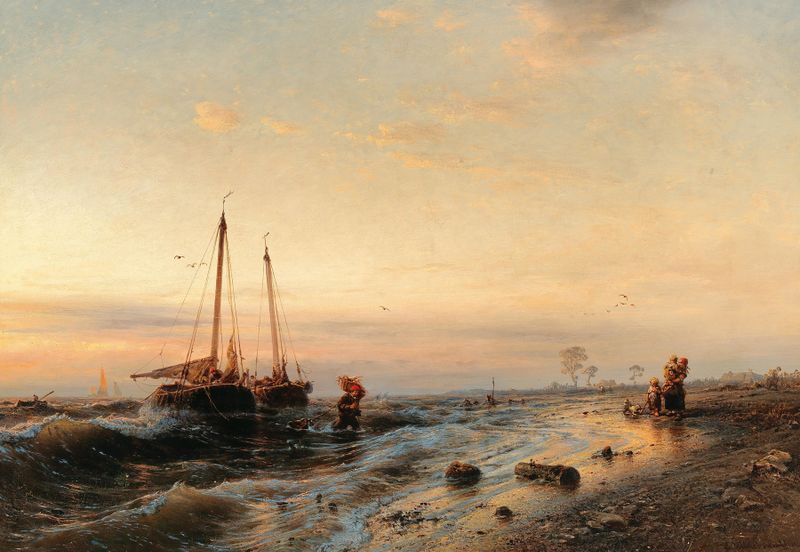
The arrival of the fishing boats
Eduard Hildebrandt

Landscape with Black People
Eduard Hildebrandt

Crows in an Open Winter Landscape
Eduard Hildebrandt





