
Joyful Entry of the Duke of Anjou in Antwerp on 19 February 1582 — History & Facts
Who listens when art speaks of silence? In the bustling scene of Joyful Entry of the Duke of Anjou in Antwerp on 19 February 1582, we are drawn into a kaleidoscope of movement and merriment that contrasts sharply with an undercurrent of solitude. Focus first on the vibrant crowd filling the canvas. Notice how the figures to the left are adorned in lavish garments, their faces illuminated by the warm glow of the sun, suggesting a festive atmosphere. As your gaze wanders to the right, the intricate architecture framing the scene becomes apparent, its towering spires almost reaching out to the heavens.
The painter's deft use of rich colors — deep reds, gleaming golds, and lush greens — enhances the celebratory mood, while subtle shading invites a deeper exploration of the characters' expressions and postures. Yet beneath the jubilant surface lies a tapestry of unspoken narratives. The joyous reception of the Duke juxtaposes the solitary figures lurking at the canvas's edges, hinting at their feelings of isolation amidst the crowd. The grandeur of the occasion reflects not only the public's adoration but also the private yearnings and anxieties of those on the fringes, whispering stories of longing and loneliness in a time of celebration. Created between 1582 and 1600, this work emerged during a period marked by turmoil and shifting allegiances in Europe.
The artist, operating under the moniker MHVH, was part of a world where political spectacles sought to unify communities. Yet, in this portrayal of festivity and allegiance toward the Duke of Anjou, there exists a poignant commentary on the complexities of human connection, revealing that even in the clamorous joys of public life, solitude can reside silently within the crowd.
More Artworks by Monogrammist MHVH
Browse all →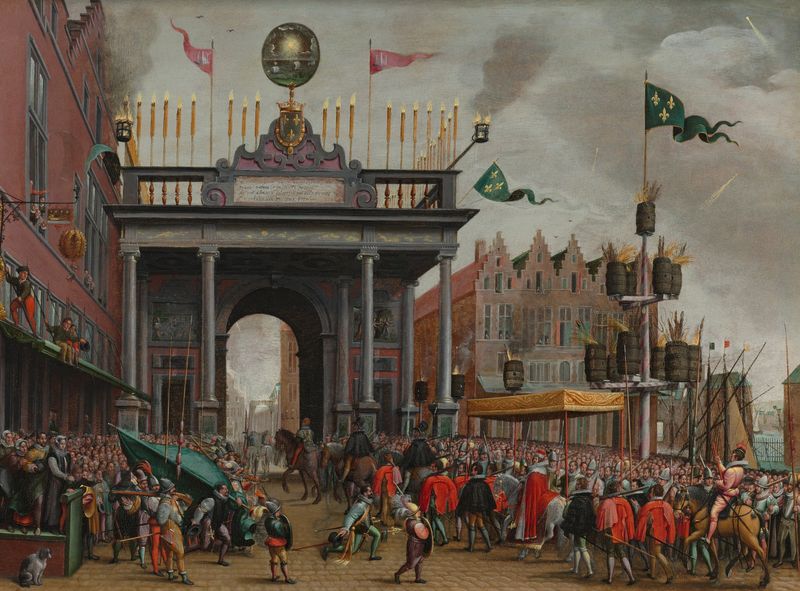
More Historical Art
Browse all →
The Night Watch Militia Company of District II under the Command of Captain Frans Banninck Cocq
Rembrandt van Rijn

Lincoln Memorial
Henry Bacon

The Third of May 1808
Francisco de Goya

Isaac and Rebecca, Known as ‘The Jewish Bride’
Rembrandt van Rijn

The Charge of the Mamelukes (1814)
Francisco de Goya

De vier ruiters van de apocalyps
Albrecht Dürer