Landscape in Limburg — History & Facts
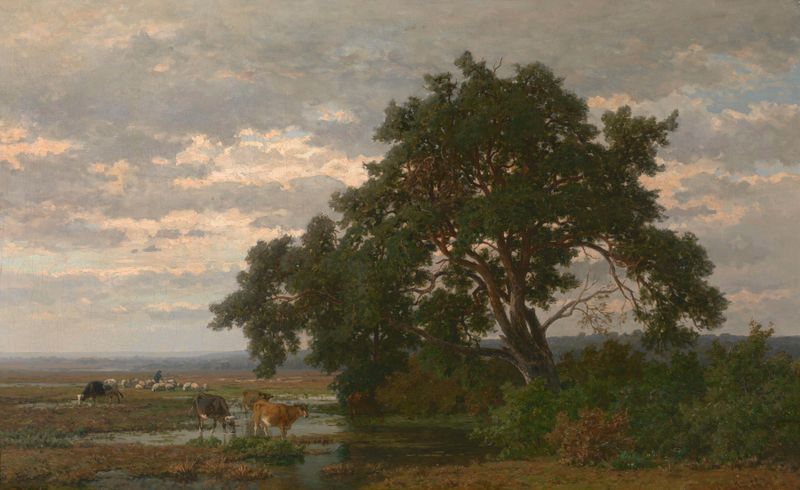
When did color learn to lie? In the brushstrokes of a hidden longing, Landscape in Limburg evokes a bittersweet nostalgia that speaks to the heart. Look to the center, where a luminous sky unfurls above the rolling hills, infused with hues of soft blue and warm ochre. The gentle contours of the landscape guide the eye, leading to a distant horizon that suggests both promise and uncertainty. Every blade of grass, every cloud, is rendered with meticulous attention, creating a harmonious interplay between light and shadow that breathes life into the scene. Beneath the surface lies a profound emotional tension—the landscape, while beautiful, whispers of absence.
The trees stand sentinel, their branches reaching out yet holding back, as if guarding secrets of the past. This delicate balance between tranquility and yearning invites the viewer to ponder: What is it that lies beyond the horizon? What memories linger in the quiet spaces between the strokes? Frans Keelhoff painted Landscape in Limburg in 1886 during a period marked by a growing appreciation for the Dutch landscape tradition. He found himself amidst an evolving artistic landscape, where Impressionism was beginning to influence many painters, yet he remained rooted in a classical approach.
This painting reflects not only his personal journey but also a broader transition in the art world, one that grappled with the relationship between nature and emotional expression.